
Meta Age Detection AI Has a Blind Spot
Key Takeaways
- Meta’s age-detection AI aims to improve age verification by analyzing various account details and visual cues in photos.
- However, it can only analyze digitized photos, leaving printed family photos invisible to AI tools.
- Old printed photos need to be scanned first to unlock AI capabilities such as organization, restoration, and search.
- Scanning services can bridge this gap, converting physical photos into digital files for easier access and use with modern technology.
- The future of family photo technology depends on digitizing cherished memories so they can be searchable and shareable.
Estimated reading time: 5 minutes
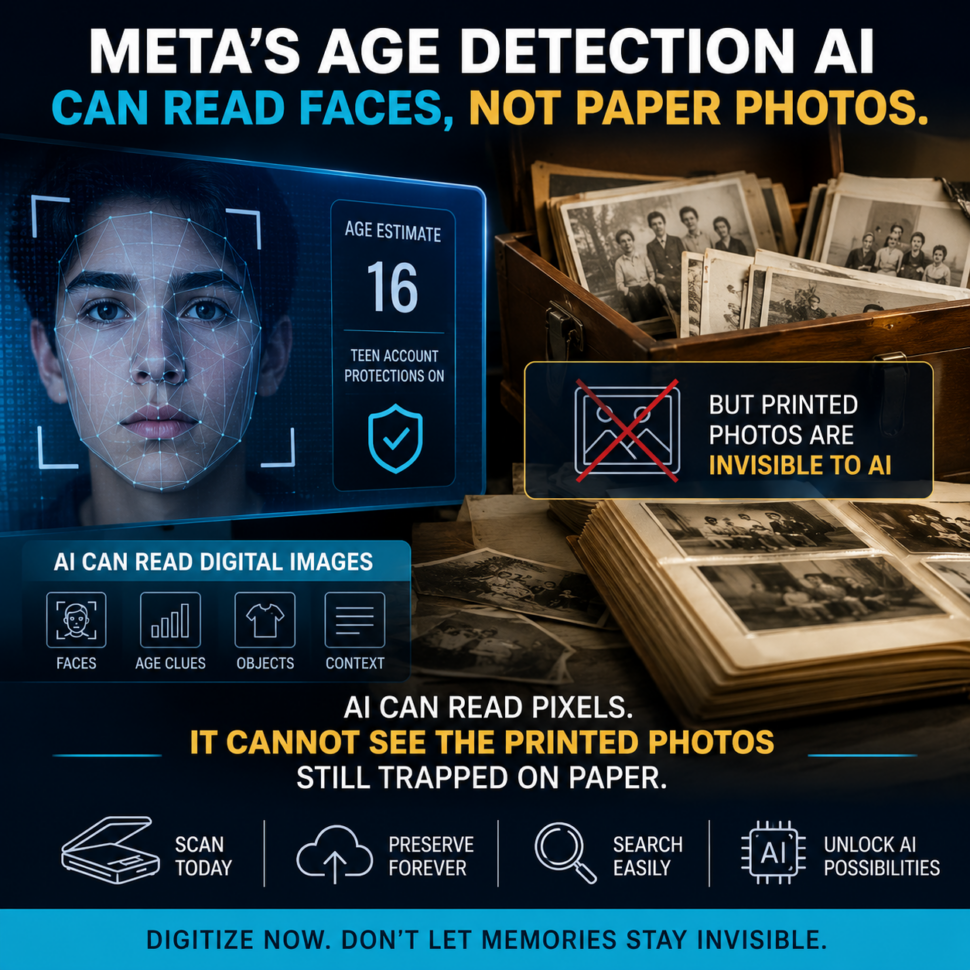
Meta is working on making age verification on Instagram and Facebook more reliable, especially to catch cases where teens enter the wrong birthdate or younger kids try to join. They’re using AI to analyze account details, posts, captions, comments, activity, and visual cues in photos and videos to better estimate someone’s age. This isn’t facial recognition; they are seeking general signs that might indicate a person’s age. If accounts are suspected to belong to children under 13, they might be removed unless the owner can verify their age. Additionally, Meta is strengthening protections for Teen Accounts, providing more guidance to parents, and encouraging app stores to verify ages to ensure a safer experience for young users across all apps.
AI can study a photo in seconds. It can spot faces. Read visual clues. Sort images. Restore faded details. Help organize years of digital pictures. That is why Meta’s new AI age-detection tools are getting so much attention. They show how fast photo analysis is moving. But there is a part of the story most people are missing.
AI can only interpret photos that have already been digitized. This means those cherished pictures tucked away in old albums, envelopes, drawers, closets, and photo boxes are still out of reach — not because they’re unimportant, but because they haven’t been scanned yet.
When you ask someone to find a photo from last weekend, they’ll probably pull it up on their phone in just seconds. But ask them to find a printed photo of their mother from 1978, or their grandparents on vacation, or their childhood home, or the last precious picture of someone they loved — and that search might feel a whole lot more meaningful, and a little more challenging. Now it is not a search bar. It is a box. That is the missing link in the AI photo boom.
People are curious about what AI can do with old photos. They wonder if AI can organize, restore, search, or even help identify relatives in family pictures. The good news is, it can—once the photos are digitized.
That is the strange split in family history today.
Our newest photos (in our camera roll) are backed up, searchable, and ready in seconds. Our oldest photos, often the ones people care about most, are still trapped offline. Those are the childhood pictures. The wedding photos. The military portraits. The holiday snapshots. The family reunions. The old neighborhoods. The pets. The grandparents. The people who may no longer be here.
They were saved because they mattered to us. But saving something isn’t quite the same as being fully prepared. This becomes so clear when someone suddenly finds they need it—maybe for a memorial service, a Mother’s Day tribute, or a milestone birthday. It could be for a graduation video, a family reunion, a move, or even an estate cleanout. Sometimes, during a wildfire evacuation, a child asks, “Do we have any old pictures of them?” These moments remind us how important it is to cherish and keep what matters close.
The worst time to search for your most important photo is the moment you need it. That is where photo scanning services like ScanMyPhotos fit into the AI story.
Before AI can help restore, organize, search, colorize, identify, or build a family timeline, the printed photos first need to be converted into digital files. Scanning is the bridge between the photo box and everything modern photo technology can do. Once old photos are scanned, families can back them up, share them, organize them, search them, and use them with today’s AI photo tools. A box of pictures becomes a real family photo archive. A hidden snapshot becomes findable. A fragile memory gets a second copy.

This is not only about technology. It is about access. A photo that cannot be found cannot be shared. A memory that exists in only one box has no backup. A family archive that has never been digitized is still outside the digital world.
AI can do amazing things with pictures. But it cannot open your closet. It cannot flip through your albums. It cannot read your old photo boxes.
The future of family photo technology starts with one simple step. First, your past needs to be digitized.
Meta AI Age Detection FAQs
Why are printed family photos invisible to AI? Printed family photos are invisible to AI because they are not digital files. AI tools need digital image data to search, identify, restore, organize, or analyze a picture.
Can AI organize old family photos? Yes, but only after the photos are scanned. Once printed photos are digitized, AI tools may help search for faces, recognize objects, restore images, and organize family photo archives.
What is the best way to make old photos searchable? The first step is to digitize them. Once old photos are scanned, they can be backed up, named, organized, searched, shared, and used with modern photo tools.
[edited May 5, 2026].