
Should You Scan Negatives or Photos? The Answer Surprises Most Everyone
If you have just a minute, key takeaways
- Most people prefer scanning printed photos because it’s easier and cheaper, and it often yields excellent results.
- Negatives hold original details and may be necessary for large enlargements, but aren’t always better for everyday use.
- Always keep the negatives, as they are the original source and a crucial backup for future scanning.
- Proper storage is essential for film negatives; use archival sleeves and keep them in a cool, dry place.
- Digitizing photos protects memories from fading and loss, making it essential for preserving family history.
Estimated reading time: 7 minutes
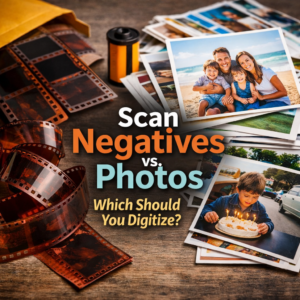 Most people begin digitizing the photos they can see. But tucked inside old envelopes is often the original film negative. Which one should you scan? The answer depends on your goal. In most cases, scanning the photograph is the easiest and most practical choice. But the negatives still play an important role.
The Hidden Treasure Inside Photo Envelopes
Open a drawer in nearly any home, and you’ll see the same scene: a shoebox filled with printed photos, a stack of envelopes from old photo labs, and inside many of those envelopes, thin strips of film that most people haven’t looked at in decades. When families start digitizing their photos, they naturally reach for the printed photos first. They are easy to see and handle, and they already resemble the image everyone remembers. But those strips of film are important—they are the original source from which the photos were printed. In some cases, they can produce highly detailed scans. Still, for most families, the printed photographs are actually the best place to start.
A Question That Reveals a Surprising Truth
Over the years, when people reach out to ScanMyPhotos, they start asking: Which is better? Scanning negatives or actual photographs? A hard fact is that whenever people decide to digitize their photo collections, ScanMyPhotos asks: “When was the last time you looked at these pictures?” The answer is almost always the same. 96% say they have not looked at their printed photos since picking them up from the photo lab. When we began tracking responses, the results were remarkable. About ninety-six percent of people had not looked at their printed photos again after they were developed. That means millions of memories have been sitting quietly in boxes for years, often with the original negatives still stored nearby in the same envelopes.
Why Scanning Printed Photos Is Usually the Best Choice
Many people assume scanning negatives will always produce better results. In reality, for most families, scanning the printed photograph is the preferred option. Printed photos are much easier to digitize, far less expensive to scan, quicker, and often nearly identical in quality for everyday use. If your goal is to safeguard your memories, share them with family, and create normal-sized reprints, scanning the photographs usually provides excellent results.
A typical print already represents the version people remember. The photo lab adjusted it for color, brightness, and exposure when it was originally developed. When you scan that print at a good resolution, the digital copy will look very similar to the original photo. For most people, scanning the print preserves the memory beautifully while keeping the process simple and affordable.
When you’re ready to get your photos or 35mm film negatives scanned, here’s how to get started.
When Scanning Negatives Makes a Difference
Sometimes, scanning the original film negative is worth the extra effort. A 35mm negative is quite small, but it can hold a vast amount of image information. When scanned carefully at high resolution, it can uncover additional details that the printed photo might not show. This is especially important if someone needs very large enlargements or museum-quality reproductions. Photographers, historians, and archivists often scan negatives to achieve the highest level of detail for large prints or professional restoration work.
For everyday sharing, however, the difference between a well-scanned photograph at either 300 or 600 dpi resolution and a negative scan is often minimal.
The Smart Approach
The most practical solution is a balanced one. Start by scanning the printed photographs. This lets you digitize large collections quickly and affordably. Those scans will be perfect for protecting the memories, sharing them with relatives, and making normal-sized reprints. If there are a few particularly important images, such as weddings, historical family moments, or photographs that may need large enlargements someday, then scanning the negatives for those specific pictures can provide extra detail. By doing both when necessary, you preserve your memories while keeping the process manageable.
Always Keep the Negatives
Even if you scan the prints, never discard the negatives. The negative remains the closest thing to the original photograph that exists. Think of it as the master recording of the image. The print is just one version created from that original film. Keeping the negatives offers a crucial backup. If a photo gets lost or damaged, you can still use the negative to produce a new scan later. Technology keeps advancing, so scans done years from now might show even more detail. Those small strips of film could someday be your most important backup.

The Best Way to Store Film Negatives
Proper storage can help negatives last for many decades. The goal is simple: keep them cool, dry, and protected from light and damage. Negatives should ideally be stored in archival plastic sleeves or paper envelopes designed for photographic film. These sleeves keep the film separated, preventing the frames from scratching each other. It is best to store the sleeves inside archival boxes or folders rather than leaving them loose in drawers. The storage area should remain relatively cool and dry. Avoid places like attics, garages, or basements where temperature and humidity change dramatically.
Handling film carefully is also important. Oils from fingers can leave marks on the film surface, so it is best to hold negatives by the edges whenever possible. When stored properly in a stable environment, film negatives can survive for generations.
Why Digitizing Photos Matters Now More Than Ever
Printed photographs used to be the final way to keep family memories. People developed their film, put the prints in albums, and rarely looked at them again. Today, things are different. Once photos are digitized, they can be securely backed up, easily shared with loved ones, and preserved. Digitizing also shields photos from fading, water damage, and loss. A digital copy makes sure the moment won’t disappear, even if the original print eventually wears out. For many, digitizing their pictures is the first time they’ve seen their photo history in years.
The Power of That Small Strip of Film
Inside old photo envelopes may be a better version of the picture you remember. The negative often holds the original detail captured by the camera. But the print remains the version people recognize and love. For most families, scanning the photographs themselves is the easiest and most practical way to preserve their memories. The negatives then remain safely stored as the backup, ready if they are ever needed again. Together, they form the complete record of a moment that might otherwise be forgotten.
Scanning Photos Vs. Negatives, Frequently Asked Questions
Is it better to scan negatives or printed photos? For most uses, scanning the printed photos is preferred because it is simpler, less expensive, and produces excellent results for sharing and normal-sized reprints. Negatives are mainly useful when very large or museum-quality enlargements are needed.
Why keep the negatives if I scan the photos? Negatives are the original source of the photograph. Keeping them provides a valuable backup and allows future scans to capture even more detail if needed.
How should film negatives be stored? Store negatives in archival sleeves inside boxes or folders. Keep them in a cool, dry place away from sunlight, heat, and humidity. Avoid attics and garages where temperatures change dramatically.
Can old negatives still be scanned after many years? Yes. Many negatives from decades ago can still be scanned successfully if they have been stored properly. Even older films often contain remarkable detail that can be recovered through modern scanning.
[Revised March 4, 2026]