Urgent Photo Scanning When Time Matters
- Urgent photo scanning often arises from real-life events like funerals, health emergencies, or unexpected moves.
- People need photos scanned quickly, as urgency adds pressure and emotional weight to the task.
- A steady, careful process ensures that photos are preserved while respecting the requester’s situation.
- Clear communication helps manage expectations, and urgent photo scanning aims to provide reassurance.
- Understanding the emotional context behind urgent photo scanning is crucial for effective service.
Estimated reading time: 4 minutes
It begins with a moment. A phone call. A request. A date on the calendar that suddenly feels too close. Boxes of photographs pulled from a closet. The dry texture of old paper. The faint smell of cardboard and time. In those moments, photos are no longer just memories. They become something you need access to now.
As a professional photo archivist, I see this pattern most often.
Why do people suddenly need photos scanned fast?
Urgent photo scanning is almost always tied to real-life events, not convenience.
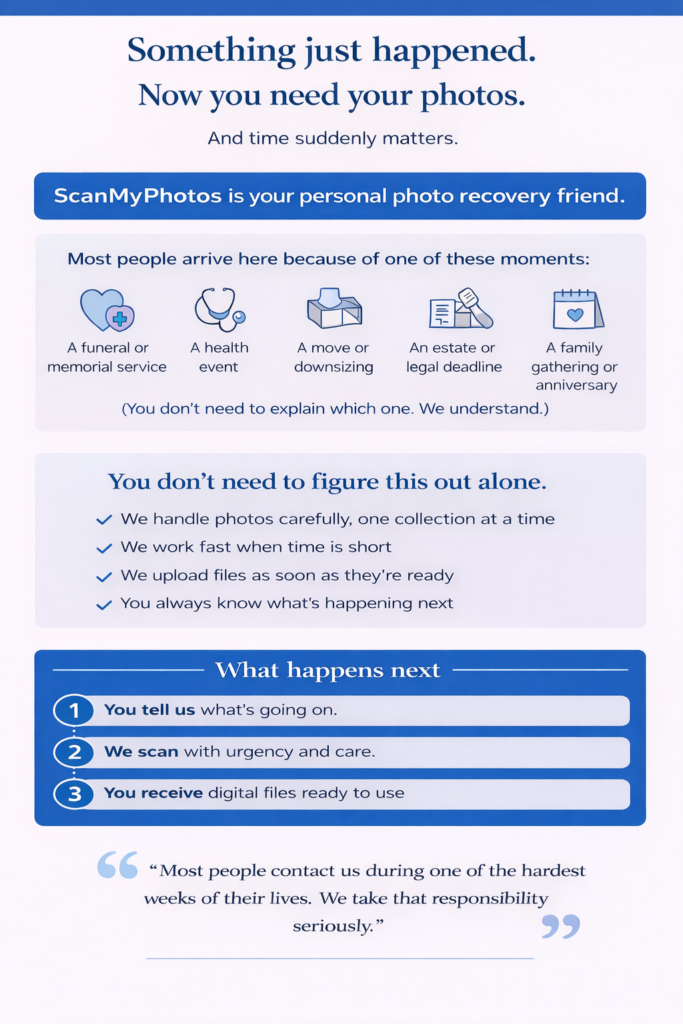
People usually arrive because of situations like these:
✅ A funeral or memorial service that needs photos for a slideshow
✅ A health emergency where family history becomes important
✅ A move or downsizing with little notice
✅ An estate or legal request involving original photographs
✅ A family gathering or anniversary that arrives sooner than expected
These moments compress time. Photos that sat untouched for years suddenly matter.
“I didn’t expect to need them that week.”
“My brother passed unexpectedly, and we needed photos for the memorial within days. The boxes were heavy, dusty, and unorganized. I felt behind before I even started.”
— Laura, Denver
This experience is common. People know the photos exist. They simply never imagined needing them urgently.
Why urgency feels overwhelming
Urgency adds pressure. Emotion adds weight.
Handling fragile prints while managing grief, responsibility, or change can feel exhausting. Faded faces. Curled edges. Notes written on the back in familiar handwriting.
In those moments, what helps most is knowing what happens next.
What matters when time is short
From an archival standpoint, urgency does not mean carelessness.
A steady process makes the difference:
✅ Photos handled carefully, one collection at a time
✅ Scanning prioritized without rushing
✅ Digital files shared as they are completed
✅ Clear communication so there are no surprises
This balance protects both the photographs and the people waiting for them.
“I just needed clarity.”
“We were moving my mother into assisted living and needed photos for paperwork. I wasn’t looking for options. I needed someone to explain the next step.”
— James, Atlanta
Most people are not searching for technical details. They are searching for reassurance.
What happens next in urgent photo scanning
The process should feel simple.
First, explain what is going on. One sentence is enough.
Next, photos are scanned with urgency and care.
Then, digital files are delivered ready for viewing, sharing, or preservation.
No guessing. No backtracking. Just forward movement.
A quiet truth from photo archives
Most urgent photo scanning requests arrive during one of the hardest weeks of someone’s life.
That is not an assumption. It is a pattern observed over decades of archival work.
When photos matter urgently, something meaningful is happening. That deserves patience and respect.

Final guidance
If you are reading this because something just happened, you are not behind.
You are responding to a moment that matters.
Urgent photo scanning is not just about speed. It is about helping people move forward with less uncertainty.
Frequently asked questions
How fast can urgent photo scanning be done?
Many services begin scanning immediately and upload files in stages, so you can access images as they are ready. Select Express ScanFast at ScanMyPhotos.
Do photos need to be organized first?
No. Most collections are scanned upon receipt.
Is urgent photo scanning only for emergencies?
No. But emergencies are often when people realize how important digital access to photos can be.