
Key Takeaways
- Sticky residue ruins photos due to outdated adhesives and environmental factors.
- Remove stickiness quickly to avoid permanent damage like discoloration and mold.
- Follow golden rules like working on a clean surface and testing methods on corners first.
- Use techniques like the Gentle Scrape Method and Freezer Method for safe removal.
- Always digitize photos after cleaning to preserve family memories for the future.
Estimated reading time: 6 minutes
Stop Sticky Residue From Ruining Photos
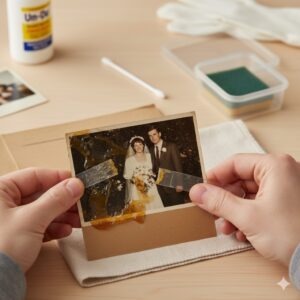 How to Remove Sticky Residue from Photos (Safely, Easily, and Without Ruining Them)
The moment you try to peel an old photo from a sticky album page and feel it resist… your heart stops. These aren’t just pictures. They’re your childhood. Your parents’ wedding. The only photo of someone you miss. And now the back is covered in sticky, gummy residue that could destroy it forever. Good news: you can safely remove sticky residue from photos—if you know what causes it, what NOT to do, and the right methods professionals use. Here is how to protect your photo memories the smart way.
Why Do Photos Get Sticky in the First Place?
Sticky residue isn’t your fault. It happens because Old “magnetic” albums used glue that breaks down over time. Scrapbook adhesives become acidic and ooze. Heat and humidity react with glue. Photos press together and fuse. Cheap tapes and glue sticks never fully dry. Chemical interaction between the photo paper and the adhesive. Over time, that goo turns into a trap. It grabs onto the back of the photo and refuses to let go.
Photograph Preservation 101: How to Get Glue off of Photos
Why You MUST Remove the Stickiness Now (Before It’s Too Late)
Leaving the sticky residue can:
✅ Stain or discolor the image
✅ Cause mold or mildew from trapped moisture
✅ Fuse two photos together permanently
✅ Tear when moved
✅ Eat away the emulsion layer
✅ Make scanning impossible
✅ DESTROY the only copy of that memory
Sticky is not “just messy.” Sticky is dangerous.
BEFORE You Remove Anything: Follow These Golden Rules
✅ Wash and dry your hands (oils transfer!)
✅ Work on a clean, flat surface
✅ Go slow—this is surgery, not speed
✅ Test every method on a corner first
✅ Stop immediately if you see damage
The 5 Best Ways to Remove Sticky Residue from Photos (Safely)
These methods are used by archivists, preservationists, and yes — by us at ScanMyPhotos.com.
I’ve rewritten and enhanced every technique with expert-level detail so you get the safest, most effective version.
1. The Gentle Scrape Method (Start Here). Best for: Small glue spots, light residue. Use: Fingernail, plastic scraper, scalpel, or razor.
How to do it:
- Hold the photo flat.
- Slowly nudge the edge of the glue.
- Lift or roll the glue—don’t dig.
- Stop if you hit resistance.
✅ PRO TIP: Use a plastic tool instead of metal to reduce the risk of scratching.

2. The “Sweatbox” Humidity Method (Stamp collector trick!)
Best for: Large areas of sticky album pages. How to do it:
- Place a damp sponge in a sealed container.
- Add wax paper above the sponge.
- Place the photo on top, glue side up.
- Close the container. Wait 12–24 hours.
- Check regularly—do NOT let the photo get wet.
- When glue softens, gently rub or lift it off.
- Why it works: Humidity loosens the adhesive without soaking the photo.
3. Low-Heat Blow Dryer Method
Best for: Tackiness or stubborn adhesive. Important: LOW HEAT ONLY. Never high heat. Steps: Hold the dryer 6–8 inches away. Move back and forth for a few seconds. Test glue—if it softens, gently peel/scrape.
✅ PRO TIP: Heat too long = warped photos. Work in short bursts.
4. Freezer Method (Opposite of heat—also brilliant!)
Best for: Thick, rubbery glue that won’t budge. Steps: Put the photos in a sealed bag or container. Freeze for 5–10 minutes. Remove quickly. Scrape before it warms up. Cold makes glue brittle… and brittle glue POPS off.
5. Adhesive Solvent (Last Resort)
Best for: Glue that NOTHING else removes. Use products like Un-Du Adhesive Remover or archival-safe solvents. Steps: Test a tiny corner first. Apply with a cotton swab — minimal moisture. Dab, don’t soak. Gently lift residue. Dry completely. ❌ If the photo changes color or smears—STOP immediately.
What NOT to Do (These Destroy Photos)
❌ Don’t pull or yank the photo
❌ Don’t soak in water
❌ Don’t use rubbing alcohol
❌ Don’t use Goo Gone, acetone, nail polish remover, or household cleaners
❌ Don’t use tape (sounds obvious, but people try it!)
❌ Don’t ignore humidity or mold—act fast
Extra Pro Preservation Tips From the Photo Archivists at ScanMyPhotos.
✅ Work in a room with low humidity
✅ Use acid-free sleeves after cleaning
✅ Store photos flat, not stacked
✅ Avoid hot attics/garages
✅ Scan BEFORE attempting removal if possible
**REAL STORY #1: Linda’s Wedding Photo Scare**
“I tried to pull a picture from my old album, but half of the back remained glued to the page. I thought I had ruined it forever. I used the sweatbox trick, and it lifted off like magic. You saved my wedding photo from 1982!”
REAL STORY #2: Marcus Found a Gold Mine
“My grandma’s scrapbook was stuck. I froze one page at a time and gently scraped it. Those baby photos of my mom? Priceless. Now they’re scanned and shared with the whole family.”
The Smartest Step After Cleaning… DIGITIZE
Even if you remove the sticky residue… Even if the photo looks “fine”… That photo is still aging. Time, humidity, and chemistry are still eating away at it. Digitizing is the only proper protection.
Related Post You’ll Love
How to Get Photos Out of Old Sticky Albums Without Damage
Removing Glue From Photos FAQs:
Q: Can I use water to remove sticky residue? No. Water can cause warping, bubbling, ink bleeding, and permanent damage.
Q: Is it safe to freeze photos? Yes—short bursts (5–10 minutes) in an airtight container are safe and effective.
Q: Should I scan my photos before or after removing sticky residue? If the photo is at risk, scan it first! Once it’s digital, you can attempt removal with less fear.
Final Thought
These photos are not just paper. They’re laughter. Tears. Roots. Legacy. Taking the time to remove the sticky residue the right way isn’t just “cleaning”… It’s preserving your family story. And if you want the safest, fastest, most emotional way to protect them.
Revised on October 19, 2025.