Before Your Parents’ Photos Become Mysteries
Key Takeaways
- Start digitizing old family photos now to preserve memories and stories before they fade away.
- Focus on one box or album at a time to avoid feeling overwhelmed during the process.
- Ask simple and deeper questions about the photos to capture meaningful stories from relatives.
- Don’t forget to include slides, negatives, and home movies as they often hold unseen memories.
- The goal is to save not just images, but the stories behind them for future generations.
Estimated reading time: 12 minutes

The first thing to do with your parents’ old photos is ask about the stories while someone can still answer. Start with one box, identify the people and places, record the memories, then digitize the photos, slides, negatives, and home movies so they can be preserved and shared.
Old family photos are not just pictures. They are memory triggers. They can show you a face, a birthday, a wedding, a backyard, a vacation, or a kitchen table. But they cannot tell you who was there, what happened before the picture was taken, why everyone was laughing, or what that moment meant. Only the people who lived it can do that.
That is why the real danger is not just fading color, cracked albums, damaged film, or boxes stored in a hot attic. The bigger risk is losing the names, voices, places, and stories attached to those images. A photo can survive for decades and still become a mystery if nobody remembers who is in it.
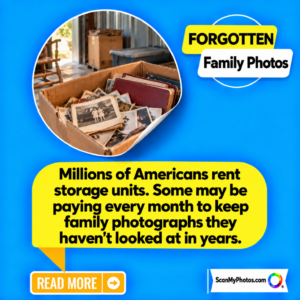
If your parents still have boxes of photographs, albums, 35mm slides, negatives, home movies, VHS tapes, or old film reels tucked away in closets, garages, attics, storage units, or spare bedrooms, the most important thing you can do is begin now.
After my father died when I was a child, one ordinary photograph became priceless to me. Not because it was perfect. Not because it was rare. It mattered because it was proof of a moment I could never get back.
That is what family photos do. They stop time. They bring people back into the room. They remind us of voices, places, smells, jokes, holidays, kitchens, backyards, birthdays, vacations, and ordinary days we did not know would someday mean everything. Preserving old family photos is not really about photographs. It is about preserving people.
Start With One Box, Not the Whole Collection
The biggest mistake families make is thinking they have to organize everything at once. They see twenty boxes, five albums, three carousels of slides, a drawer full of negatives, and a stack of old videotapes. Then they freeze. It feels too big, too emotional, too messy, and too easy to put off.
Do not start with the whole collection. Start with one box. Pull out a small group of photos. Sit with your parent, grandparent, aunt, uncle, sibling, or anyone who might know the stories. Ask simple questions. Listen carefully. Write things down. Record audio or video if they are comfortable. The goal is not perfection. The goal is conversation. One photo can bring back a story nobody has heard in years. One name written down today can save future generations from wondering forever.
Ask Before the Photos Become Mysteries
Every unlabeled photo is a future mystery. Start with the easiest questions. Who is in this picture? Where was it taken? About what year was this? Who took the photo? What was happening in your life then? What do you remember most about that day? Why was this moment important enough for someone to take a picture?
Then ask deeper questions. Who in this photo had the best sense of humor? Who was the family troublemaker? What was that house like? What did the kitchen smell like? What music was playing in those years? What family story should not be forgotten? Which photo means the most to you? Who do you wish you could talk to again?
Do not worry about asking perfect questions. Just ask something. A photograph can show a wedding. Your parents may remember who cried, who gave the funniest toast, who almost missed the ceremony, and what happened after the camera was put away. A photograph can show a house. Your parents may remember the sound of the screen door, the smell of Sunday dinner, the neighbor who always came over, or the room where everyone gathered.
The most valuable part of a family photograph often exists outside the frame. It is the story.
Do Not Forget Slides, Negatives, and Home Movies
When families think about old photos, they usually think about prints in albums and shoeboxes. But some of the most important memories may be hiding in formats nobody has looked at in decades.
Boxes of 35mm slides. Kodachrome carousels. Negative strips. Super 8 film reels. 8mm home movies. 16mm film. VHS tapes. VHS-C tapes. Hi8 camcorder recordings. MiniDV tapes. These formats often contain moments that were never printed, never shared, and never seen by younger generations.
A box of slides may include a vacation nobody remembers clearly. A strip of negatives may contain the only surviving image from a family event. A reel of home movie film may show a grandparent moving, smiling, waving, dancing, laughing, or holding a child who is now grown.
There is something extraordinary about seeing someone move again after only knowing them from still photographs. A photo can show what someone looked like. A home movie can remind you how they walked, smiled, waved, turned their head, held a baby, or entered a room.
Save the Meaning, Not Just the Image
Digitizing old photos is important because it makes them easier to organize, preserve, search, copy, and share. Once a photo is digitized, it can be sent to family members, displayed at reunions, backed up, added to family trees, used in memorial videos, and preserved beyond the original print.
But digitizing alone is not the whole answer. The real work is saving the meaning. Who is in the photo? Where was it taken? Why did it matter? What was happening in the family then? What story should future generations know?
A scanned photo without a name is still valuable. A scanned photo with a story is priceless. At ScanMyPhotos.com, after helping families preserve more than a billion images, one lesson stands out clearly: people rarely regret starting too soon. They regret waiting until no one can explain the pictures.
The photographs may still be there. The answers may not.
How to Label Old Family Photos Safely
Once you learn who is in a photo, save that information carefully. Do not write directly across the front of a photo. Do not use a marker that can bleed through. Do not press hard on the back of fragile prints. When possible, use soft pencil on the back edge of a print, archival-safe sleeves, sticky notes placed near the photo but not on the image, or a simple spreadsheet that matches file names with names, dates, and locations after the photos are digitized.
Even partial information helps. If your parent says, “I think that was Aunt Rose’s house in Chicago,” write that down. If they are not sure of the exact year, record the approximate decade. If they remember only a first name, save it.
Do not let uncertainty stop you. Family history is often built from fragments. A name here. A place there. A date range. A story. A correction from a cousin. A caption found years later. The goal is not to create a museum-quality archive in one weekend. The goal is to keep the trail from going cold.
How to Organize and Label Digital Files.
What to Keep, What to Scan, and What to Share
Many families get stuck because they do not know what to keep. The answer is not always obvious. The most important photo is not always the oldest, sharpest, or most formal picture. Sometimes it is the blurry snapshot. The crowded dinner table. The parent laughing. The child on a bicycle. The grandparent in the backyard. The family car packed for vacation. The old house before it was sold. Someone waving from a driveway.
Ordinary photos become extraordinary when they are the only ones left. Before throwing anything away, ask whether the picture shows a person, place, relationship, event, home, neighborhood, business, tradition, holiday, recipe, pet, car, military service, school moment, family reunion, or ordinary daily life that may matter later.
Future generations may care about things we overlook today. They may want to know what the house looked like, what people wore, how the table was set, where the children played, and what the neighborhood looked like before it changed. Photos are not just memories. They are evidence. They prove people were here.
Use Old Photos to Start Family Conversations
One of the best things you can do with old family photos is share them while people are still alive to react. Imagine your next family reunion. A large television shows photos from fifty years ago. Children stop and stare. Grandchildren point at the screen. Someone asks, “Who is that?” Someone else answers. Then a story begins.
Then another. And another. Soon everyone is laughing, remembering, correcting each other, filling in details, and bringing the past back to life. That is the true purpose of preserving old photos. Not storage. Connection.
Old photos can help children and grandchildren feel connected to people they never met. They can see where they came from. They can recognize a smile, a gesture, a face shape, or a family resemblance. They can understand that their family history did not begin with them.
That is a powerful thing.

Do This Before It Is Too Late
This is not meant to scare anyone. It is simply reality. Time wins every argument. Photographs can fade. Slides can shift color. Film can become brittle. Videotapes can degrade. Albums can crack. Storage boxes can be damaged by heat, water, mold, insects, and neglect. But memory is even more fragile.
Names become harder to recall. Details fade. Stories become shorter. Eventually, no one remains who can explain what you are looking at. That is when a photograph becomes a mystery. The image survives. The meaning disappears.
A Simple Plan for This Week
Choose one box, one album, or one stack of photos. Do not make it bigger than that. Sit with someone who may know the stories. Ask who, where, when, and why. Write down names. Record memories. Set aside photos that need more help. Look for slides, negatives, and home movies that may contain unseen moments. Decide which images should be digitized first. Share a few with family and ask what they remember.
That is enough. You do not need to finish the entire family archive this week. You just need to begin. One box becomes one conversation. One conversation becomes one saved story. One saved story becomes part of your family history.
The Real Reason to Preserve Old Photos
Someday, someone in your family may hold a photograph and ask a simple question: “Who was this?” The answer may depend on what you do today.
Your children may want to know what their grandparents were like. Your grandchildren may want to see where the family came from. A future relative may search for a face, a name, a place, or a clue that only your family’s photos can provide.
The photographs matter. The slides matter. The negatives matter. The home movies matter. But the stories matter most.
Start with one box. Ask one question. Save one name. Record one story. You may discover that what you are really preserving is not a collection of photographs. You are preserving your family’s history.
Frequently Asked Questions
What is the first thing I should do with my parents’ old photos?
The first thing to do is ask your parents or older relatives to identify the people, places, dates, and stories behind the photos. Start with one small group of pictures so the project does not feel overwhelming.
Should I organize old family photos before digitizing them?
You do not need to fully organize everything before digitizing. It helps to group photos by family, decade, event, or person when possible, but the most important step is saving the images and the stories before they are lost.
Are old slides and negatives worth saving?
Yes. Slides and negatives are often worth saving because they may contain images that were never printed. In some families, the best photos are still hidden in slide boxes, negative sleeves, or old carousels.
What should I ask my parents about old photos?
Ask who is in the photo, where it was taken, when it happened, who took the picture, what was happening in their life at the time, and what story future generations should know.
How do I label old photos without damaging them?
Avoid writing on the front of photos or using heavy markers. Use soft pencil on the back edge when safe, archival sleeves, notes kept with the photo, or digital file names and captions after scanning.
Why should I digitize family photos?
Digitizing photos makes them easier to preserve, organize, back up, search, and share with relatives. It also helps protect the memory if the original print, slide, negative, or home movie is damaged later.
What if my parents do not remember everyone in the photos?
Record whatever they do remember. Even partial details can help. A first name, city, decade, house, event, or family connection may help another relative identify the photo later.
What should I do with old home movies?
Old home movies should be preserved because they may show family members moving, smiling, speaking, waving, dancing, or holding children. These moments are often emotionally powerful because many families have never seen them before.
How can I share old family photos with children and grandchildren?
After digitizing, share photos through digital albums, family slideshows, reunion videos, memorial tributes, printed books, cloud folders, or smart photo frames.
Why is it urgent to deal with old family photos now?
The urgency is not only about the physical condition of the photos. It is about memory. Once the people who know the names and stories are gone, many photos become mysteries. Asking now can save what technology cannot recreate later.
[Revised on June 15, 2026]