
Key Takeaways
- AI Can’t See Your Old Photos due to their physical nature, which makes them inaccessible for analysis.
- Photo digitization is crucial for transforming physical memories into digital data that AI can interact with.
- Once digitized, families can rediscover and utilize their memories in engaging ways through AI tools.
- Scanning photos not only preserves them but also prepares them for deeper analysis and storytelling by AI.
- ScanMyPhotos provides essential services for large-scale digitization, bridging the gap between analog memories and digital access.
Estimated reading time: 6 minutes
The AI Photography Revolution Starts With the Photos You Forgot You Had
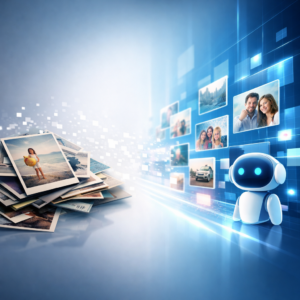
AI can’t see your old analog snapshots. AI cannot understand memories it cannot access. Photo digitization is the missing step no one is talking about. Artificial intelligence has a blind spot. It is not a technical flaw or a computing limit. It is a visibility problem. AI cannot see physical photos.
Until photo digitization happens, decades of family history do not exist for modern technology. Prints in albums. Slides in trays. Negatives in envelopes. They sit outside the digital world that AI learns from, organizes, and builds upon. Furthermore, this makes photo digitization one of the most overlooked steps in the AI pipeline. AI only works on what it can read.
AI photography tools can restore color, recognize faces, animate images, and search massive libraries in seconds. But they all rely on one thing — digital files. If a photo has never been scanned, AI cannot analyze it. It cannot tag, search, or restore it. To an AI system, a printed photograph might as well not exist.
That means a lifetime of visual history remains locked out of the future. The largest image dataset is missing from AI. Most AI image models train on photos that were born digital. Smartphones. Modern cameras. Social media uploads. That leaves out nearly a century of images. Family weddings from the 1950s. Childhoods from the 1970s. Road trips from the 1980s. These photos hold emotion, context, and continuity that modern images often lack.
Once people digitize photos, those memories become data. Searchable, usable, and trainable data. This is why photo digitization matters more than most people realize, from shoeboxes to searchable history. For many families, scanning old photos begins as a preservation effort. They want to protect prints from fading, mold, or loss. Then something surprising happens.
Once photos become digital, behavior changes. People stop flipping through albums and start asking questions.
- Show me every photo of my mom smiling.
- Find pictures from our old kitchen.
- When did my dad start wearing glasses?

AI systems respond instantly when photos are in digital form. One ScanMyPhotos customer uploaded her digitized collection to an AI chat tool out of curiosity. She expected novelty. Instead, she found discovery. The system surfaced patterns, grouped moments, and revealed photos she had entirely forgotten. Then she tried something unexpected. She asked the AI to create bedtime stories for her grandchildren, using real family photos as characters. Her granddaughter recognized her grandmother as a child and laughed until she cried. What began as photo digitization became a realization of why timing matters now.

Physical photos degrade. Film cracks. Labels fall off. Stories vanish faster than people expect. At the same time, AI tools are evolving faster than most families can keep up with. These systems increasingly rely on deep, meaningful datasets. Not stock images. Not selfies. Real lives. Digitizing photos now does two things at once.
- It protects memories from physical loss.
- It prepares them for tools that can unlock new meaning.
This is not about replacing memory. It is about making memory usable again. Why ScanMyPhotos sits at the center of this shift. Most people underestimate the scale of photo digitization. Scanning a handful of prints at home is one thing. Digitizing decades of photos, slides, and negatives requires infrastructure, consistency, and care. ScanMyPhotos operates at that scale. By converting extensive analog collections into high-resolution digital archives, they bridge the gap between the physical past and the digital future.
This is not about marketing images. It is about human data. Family data. Emotional data. And AI needs all of it. The real AI story no one is posting. The most essential photography conversation tied to AI is not about sensors or software updates. It is about access. AI changes what photos can do only after they cross the digital threshold. For millions of families, that threshold remains unopened at home. Once those photos become visible to technology, restoration, organization, storytelling, and sharing follow naturally.
The future of AI photography is not waiting in a lab or on a show floor. It is waiting in boxes.
Ten Joyful Things AI Can Do With Your Digitized Photos
Once photos are digitized and uploaded to chatbots like Grok, Gemini, and ChatGPT, a whole new kind of joy arrives fast. You can search your life like Google. Instantly find every smile. Ask which photos include your childhood home. Restore faded colors in seconds — group pictures by people without tagging. Create bedtime stories from real family photos. Make video animations to virtually bring people back to life (spoiler alert, it’s very emotional. Write captions you never had words for. Spot patterns across decades. Turn memories into slideshows on demand. And maybe best of all, rediscover moments you forgot existed. What used to sit in boxes becomes playful, searchable, and alive again.
Frequently Asked Questions: AI and Digitizing Pictures
What is photo digitization? Photo digitization is the process of converting printed photos, slides, and negatives into digital image files.
Why does AI need digitized photos? AI systems can only analyze digital files. Scanning old photos allows AI to search, organize, and enhance them.
Is professional photo digitization better than DIY scanning? Yes. Professional services and their photo archivists have heart, handle large volumes safely, produce consistent quality, and protect original photos.
[Revised January 4, 2026].