
Every box tells a family story. Together, they reveal something bigger about America
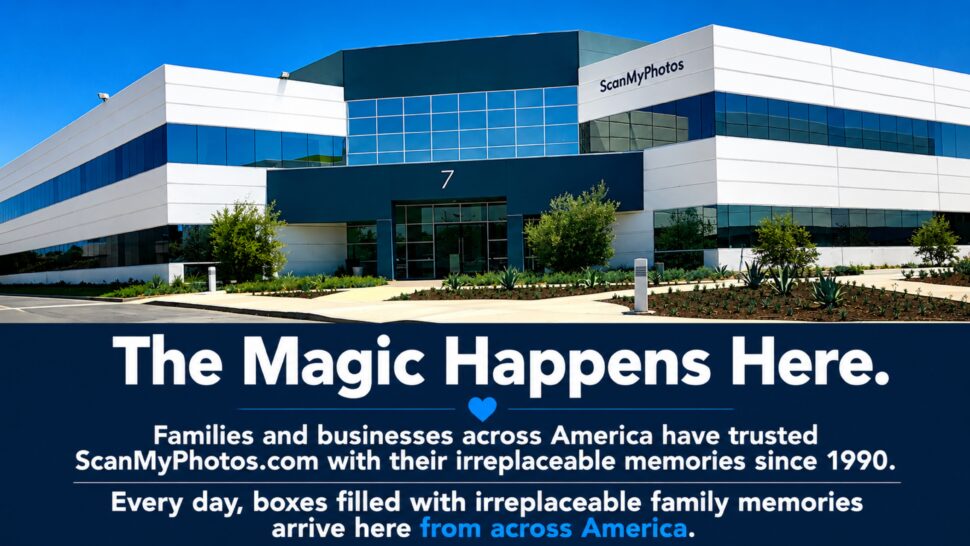
All day long, brown cardboard boxes arrive at the ScanMyPhotos corporate headquarters in Irvine, CA, from all over the country. Some are packed with almost obsessive care. Others look as though someone found the nearest box, folded the flaps, wrapped it in tape, and hoped for the best. The handwriting changes. The return addresses change. Some come from cities I know well. Others come from towns I have never visited.
Before we open a box, it has already told us something important. Someone decided the memories inside were too valuable to keep sitting in a closet.
A Business Built on Trust
After 36 years as photo archivists, we’ve come to understand that people aren’t just sending us photographs. Instead, they’re sharing their most cherished memories — the only baby pictures, their parents’ wedding album, snapshots their mother carefully saved in a shoebox, and vacation photos taken before cameras were even a common part of everyday life. Sometimes, they send the final photos of loved ones who are no longer with us. This deeper understanding truly changes how we see and value our work.
From an outsider’s perspective, it’s just paper inside a cardboard box. But for the person who packed it, that box may hold the only remaining memories of a childhood, a marriage, a home, or even an entire family branch. That’s why I see ScanMyPhotos not just as a photo-scanning service, but as a business built on trust. People are sending us their most cherished possessions—things that can’t be replaced—and they rely on us to handle them with the utmost care and understanding.
The Apology Inside Almost Every Box
One thing has happened so often that I almost expect it. People apologize.
They tell us the photographs are out of order. They say they should have handled this years ago. They warn us that the envelopes are mixed together or that the albums are falling apart. Sometimes they sound embarrassed, as though a family photo collection should somehow arrive perfectly labeled and organized. It rarely does. Real family collections move from one house to another. They sit in closets, garages, attics and spare bedrooms. Someone starts sorting them, gets interrupted and never finishes. Another relative adds an envelope. A move happens. A parent gets sick. Children grow up. Years pass.
This isn’t neglect—it’s just part of life. What’s truly important is that, someday, someone will open that closet, discover the box, and realize that those photographs are worth so much more.
More History Than Anyone Expects
Families almost always underestimate how many pictures they have. Someone may believe there are a thousand photographs in the house. Once everything is gathered, there may be two or three times that many. The collection did not appear all at once. It grew slowly, one birthday, graduation, vacation, and holiday dinner at a time.
No one notices the accumulation because it happens through ordinary life. A child stands beside the front door on the first day of school. Someone buys a first car. A family moves into a new house. Grandparents visit. A cake is placed on the table. Someone reaches for a camera because the moment feels worth keeping.
Then decades pass, and those ordinary moments have become a family record. That may be what surprises people most. They thought they had a box of pictures. What they actually had was a history.
Bring every photo out of storage and give its story a chance to be seen again.
Why Imperfect Photos Matter
The photographs are rarely perfect.
Some are faded. Some have fingerprints pressed into the surface. Corners bend. Colors shift. Albums come apart. Names and dates appear on the back in handwriting nobody has seen in years. A few pictures are blurry or badly framed. None of that makes them less valuable. Sometimes the imperfections tell part of the story. A crease may mean someone carried the photograph in a wallet. A worn edge may show how often it was passed around. A handwritten name may be the only reason anyone still knows who is standing in the picture.
These photographs were not made for a museum. They were handled, shared, packed, moved, forgotten, and found again. That is what makes them feel real.
The Most Valuable Picture
People sometimes ask me about the most valuable photograph I have ever seen. There is no answer.
For one family, it may be the only picture of two grandparents together. For another, it may be a child blowing out birthday candles, a first home, or a relative sitting at the kitchen table. To anyone outside the family, the photograph may look completely ordinary. To the person who owns it, it may be the one picture that matters more than all the others. After seeing so many collections, I have learned that the value of a photograph has almost nothing to do with whether it is sharp, beautiful, or a candid silly snapshot. Its value comes from who is in it and what it brings back.
What the Boxes Reveal
Over 36 years, these photos that, way back, we developed and printed have shown me a side of America that rarely appears in newspapers or history books. I have seen front porches, family businesses, military uniforms, school plays, birthday cakes, road trips, backyard barbecues, new babies and old neighborhoods. I have watched children grow up across a stack of photographs. I have seen houses disappear, clothing styles change, and one generation quietly become the next.
Most of those pictures were never intended to document history. Someone simply wanted to remember the day. Together, however, they show what American life looked like at home. The addresses are different. The houses are different. The clothes and cars change. Yet families save many of the same things. Children. Parents. Weddings. Holidays. Vacations. Pets. The people they loved and the places they once called home.
America can look bitterly divided when you watch the news. It looks much more familiar when you see its family photographs.

The Lesson Is Time
Most people do not wait because the pictures are unimportant. They wait because they believe there will be more time.
There will be time next year to sort the box. Time to ask who is standing beside Grandma. Time to label the people nobody recognizes. Time to deal with the old slides and home movies. Then one day, the person who knew the answers is no longer there. The photograph survives. The name does not.
That is the loss people rarely think about until it happens. Preserving the image matters. Preserving the story matters just as much. Every box that arrives is a reminder that family history usually does not disappear all at once. It disappears quietly. A name here. A date there. The story behind a house. The reason everyone was gathered in the same room.
Tomorrow, More Boxes
Tomorrow morning, more boxes will arrive. I will not know where they came from or what is inside. Some will contain thousands of photographs. Others may hold only a few. Every one of them will represent the same decision. A family looked at those pictures and decided they were worth saving. After decades, that still feels like a privilege. It also feels like a responsibility I will never take lightly.
Those boxes are not filled with old paper. They are filled with the way people remember their lives.
Questions Almost Everyone Asks (FAQs)
What is the biggest mistake people make with old photographs? Most people assume there will always be time to organize, label, or share them later. The photographs often survive for decades, but the names, places, and stories behind them can disappear much sooner.
Should I save every old photograph? If you are unsure, the safest answer is usually yes. A picture that seems ordinary today may become the only image of a childhood home, a favorite pet, a long-forgotten relative, or a moment that means everything to someone in the future.
What’s the best way to make old photographs easier to enjoy? Start by getting them out of storage. Organize them, identify the people and places you recognize, and create digital copies so they are easier to search, share, and enjoy without handling the original prints.
[edited August 5, 2026].