
By Mitch Goldstone
The Pandemic Ended Years Ago. Why Are Small Businesses Still Facing 30 Years of Debt, Mounting Interest, and Federal Collection?
One of the proudest moments of my career was serving as a lead plaintiff in the historic antitrust litigation against Visa, Mastercard, and major banks. The nearly two-decade legal battle resulted in a $5.54 billion settlement for merchants. As cofounder of ScanMyPhotos.com, I saw firsthand what small businesses could accomplish by standing together. Now the federal government is collecting payments on emergency COVID loans that some small businesses could still be repaying into the 2050s.
In January, I wrote in The Hill about how a pandemic rescue became a 30-year debt trap. The problem remains unresolved. Congress should forgive outstanding COVID Economic Injury Disaster Loan balances, reimburse interest already paid by qualifying borrowers, and consider new leadership at the Small Business Administration.
Small Businesses Were Fighting to Survive. Washington Gave Them 30 Years of Debt.
When the pandemic struck in 2020, government restrictions interrupted business operations. Customers disappeared. Revenue collapsed while rent, payroll, insurance, and utility bills continued arriving.
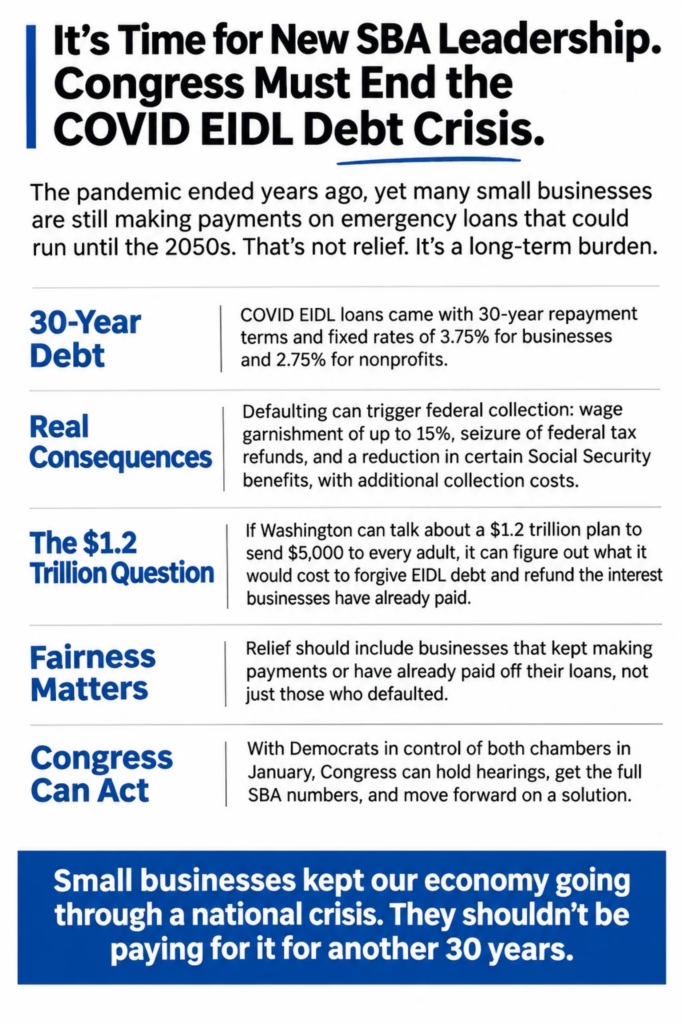
Many independent businesses were barely holding on. The SBA offered emergency financing to cover working capital and operating expenses. In September 2021, the agency expanded permitted uses to include payments on federal business debt and payment or prepayment of nonfederal business debt. COVID EIDL loans carried 30-year repayment terms with fixed interest rates of 3.75% for businesses and 2.75% for private nonprofit organizations. The SBA eventually extended the initial payment deferment to 30 months, but interest continued accumulating throughout that period.
Qualifying Paycheck Protection Program loans could be forgiven. COVID EIDL loans generally could not. Businesses facing the same national emergency received federal assistance with dramatically different long-term consequences.
Borrowers accepted loans with published repayment terms, and taxpayers have a legitimate interest in recovering federal funds. But the circumstances under which those loans were issued deserve consideration. Businesses weren’t borrowing to finance ordinary expansion. Many were trying to survive an economic shutdown.
Defaulting on a COVID EIDL loan can bring serious federal collection consequences. Loans exceeding $200,000 generally required personal guarantees, potentially putting business owners’ personal finances at risk. For individuals legally responsible for delinquent federal debt, the Treasury can garnish up to 15% of disposable wages without first obtaining a court order, subject to notice and other legal protections. It can also seize eligible federal income tax refunds and reduce certain Social Security benefits by up to 15%, subject to statutory limits and exemptions.
Collection costs and penalties can further increase the debt. Some owners have already lost their businesses, yet personal guarantees and other obligations may leave them facing collection efforts after their companies have closed.
How much more financial damage does Washington intend to inflict on small business owners who have already lost everything?
Trump Proposed $1.2 Trillion in Payments. What Would COVID EIDL Forgiveness Actually Cost?
On September 9, 2026, President Trump proposed sending $5,000 to every adult American citizen if Republicans retained control of both chambers of Congress in the November elections. The estimated cost was approximately $1.2 trillion. I found the announcement extraordinary. The proposed payment was explicitly tied to his party winning congressional elections. Critics questioned its appropriateness, while FactCheck.org raised concerns about whether the tariff revenue Trump cited could finance such an expensive program.
If Washington can entertain a proposal involving $1.2 trillion, it should be able to calculate the cost of resolving the remaining COVID EIDL debt. The SBA should provide Congress with a complete accounting of outstanding principal, interest collected, delinquent loans, charge-offs, and the results of its hardship assistance programs.
How much would it cost to forgive eligible balances and reimburse previously paid interest? How much outstanding debt is realistically collectible?
Forgiving a loan doesn’t necessarily cost the government its full outstanding face value, particularly when repayment is unlikely. Congress needs an independent financial analysis showing the expected recoveries under existing terms and the estimated cost of alternative relief programs. Without those figures, lawmakers cannot properly evaluate the financial consequences of continuing collections or authorizing forgiveness.
Businesses That Continued Paying Shouldn’t Be Penalized.
Any forgiveness proposal must account for borrowers who continued making payments, even when doing so placed considerable pressure on their businesses. Consider two companies that received comparable emergency loans. One remained current by cutting expenses and making difficult financial decisions. The other defaulted. If Congress forgives only outstanding balances without considering payments already made, the company that struggled to meet its obligations could receive less relief.
That’s why reimbursement of previously paid interest deserves serious consideration, including for eligible borrowers who have fully repaid their loans.
Congress would need to establish eligibility requirements addressing closed businesses, charged-off loans, previously repaid balances, and genuine financial hardship. Fraudulent borrowing must be excluded, with safeguards to protect taxpayer funds. The SBA’s February 2026 figures show approximately 36.2 million small businesses in America. They represent 99.9% of all businesses, employ 62.3 million people, and account for approximately 43.5% of the nation’s gross domestic product. Those figures describe the broader small business economy, not the COVID EIDL borrower population.
After 36 years operating a photo imaging company, I understand how closely business owners manage expenses. Money committed to long-term debt repayment is money unavailable for employees, equipment, improvements, and daily operations.
The New Congress Has an Opportunity to Address COVID EIDL Relief.
The November elections gave Democrats control of both chambers of Congress beginning in January 2027. The incoming leadership can investigate the program, demand financial records, and consider legislation. Hearings should include borrowers who remained current, those who defaulted, and owners whose businesses have closed. Their experiences would provide important context for understanding the consequences of the program’s repayment requirements.
I’d welcome Senator Elizabeth Warren’s involvement, given her experience examining financial institutions and federal accountability.
COVID EIDL operated during both the Trump and Biden administrations. Borrowers represent businesses across the political spectrum, and any proposed solution should be evaluated on its financial merits. Congressional majorities alone cannot guarantee forgiveness. Broad relief would require legislation and either the president’s signature or sufficient votes to override a veto.
The incoming Congress can begin by requiring the SBA to disclose the financial information needed to evaluate the available options.
The SBA Needs New Leadership Prepared to Resolve the Remaining Pandemic Debt.
Kelly Loeffler currently serves as SBA administrator. She has experience in business and financial services, but I believe the agency needs leadership willing to undertake a comprehensive examination of its pandemic loan portfolio and work with Congress on reforms.
Former administrators Karen Mills, Maria Contreras-Sweet, and Isabella Casillas Guzman have experience in federal small business policy, banking, or pandemic lending. I haven’t established whether any would consider returning to government service or support the forgiveness and interest reimbursement proposals I’m advocating. Their individual records would also warrant examination.
The president generally determines whether to replace the SBA administrator, and a successor ordinarily requires Senate confirmation. Regardless of who leads the agency, Congress needs reliable financial records and a realistic assessment of the remaining loan obligations. Some businesses that accepted emergency financing in 2020 could still be making payments in 2050. Others have already closed, leaving owners to confront the financial consequences of loans originally intended to keep their companies operating.
Congress should calculate the cost of forgiving eligible outstanding balances, determine how previously paid interest could be reimbursed, and examine the consequences of continuing federal collection under existing terms.
The pandemic ended years ago. Small businesses shouldn’t have to spend another 30 years paying for it.
Mitch Goldstone is CEO and cofounder of ScanMyPhotos.com, founded in Irvine, California, in 1990. He served as lead plaintiff in the historic payment card interchange antitrust litigation involving Visa, Mastercard, and major banks, which resulted in a $5.54 billion settlement. His January 2026 opinion article in The Hill examined the COVID EIDL debt crisis.