
The Photo Survived. Did The Story?
Key Takeaways
- Old family photos can survive, but without context, their stories may fade away.
- Engage older relatives now and ask simple questions about who, what, where, and why related to the photos.
- Focus on small stacks of photos to encourage storytelling; it’s about reliving memories, not just sorting pictures.
- Record conversations if possible, and write down names and details to keep the stories alive for future generations.
- Digitizing captures images, but asking meaningful questions about old photos preserves their importance and legacy.
Estimated reading time: 6 minutes
One day, you may still have the photo.
You may still have the box. You may still have the album. You may still have the picture of the house, the wedding, the porch, the uniform, the baby, the old car, the crowded kitchen, and the people standing shoulder to shoulder in the sun.
But nobody will know who they are. That’s the quiet heartbreak of old family photos. The paper can survive for decades, and the faces can still be clear. The moment can still be right there in your hand. Yet, if nobody asks the right questions in time, the true meaning can slip away. A photograph shows you what someone looked like, but it can’t tell you what they sounded like or why that house was so special. It can’t reveal who took the picture, who was missing from the frame, or why your mother kept that one photo in the same drawer for 50 years.
That part has to come from a person. So if your parents, grandparents, aunts, uncles, or older relatives can still talk about the pictures, ask now. Not someday. Not after the boxes are perfectly organized. Not after every photo is scanned.Now.
Start With One Stack At The Table
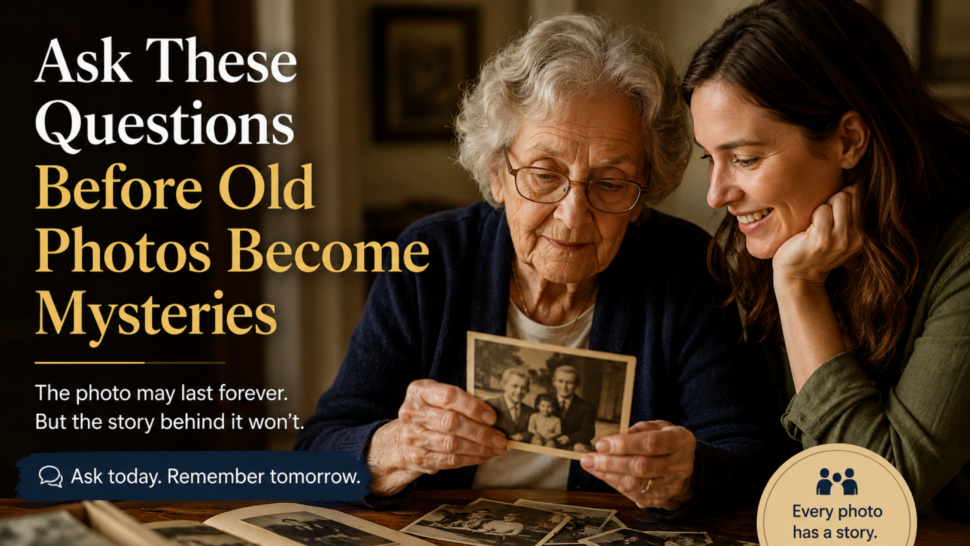
Do not begin with every box in the closet. That is too much for anyone. Start with one small stack. Sit at the kitchen table. Put out a few photos. Let the pictures move slowly from hand to hand. Keep it casual. This does not need to feel like an interview. It should feel like a visit.
Sometimes, a single photo can open a door to unexpected stories. A picture of a house might become a heartfelt tale about immigration, divorce, a first mortgage, or the place where a family finally felt truly safe. A vacation snapshot could reveal the years spent saving for that special trip. A wedding photo might bring back names that haven’t been spoken aloud in decades. That’s why even a small stack of photos is so meaningful. It doesn’t overwhelm but allows memories to breathe and come alive.
You are not just sorting pictures. You are listening for the stories that are still alive.
Ask The Simple Questions First
Start with the questions that seem almost too obvious.
Who is in this photo? Where was it taken? About what year was it? Who took the picture? Was this a special day, or just an ordinary moment? Why did you keep this photo?
Those answers are the foundation. Without them, future generations may only see strangers.
A man beside a car is just a man beside a car until your father says, “That was your grandfather and his brother the summer they drove across the country.” A woman in a dress is just a woman in a dress until your mother says, “That was my best friend. We worked together for years. She was at every important thing.”
- Now the photo has a pulse.
- Now it can be passed down.
Ask What Was Happening Outside The Frame
The best stories are often not inside the photo. They are just outside it.
Ask what was happening that day. Ask what happened before the picture was taken. Ask what happened afterward. Ask who was there but not in the frame. Ask whether the family was celebrating something, moving somewhere, saying goodbye, starting over, or pretending everything was fine.
Old photos can look calm even when life was not.
A cheerful holiday picture might have been taken during a challenging year. A graduation photo can symbolize sacrifice and hard work. A family gathering may have been the last joyful time everyone was together. A picture in front of a simple house might tell the story of a family finally achieving homeownership after many years of effort. The camera simply captured that precious scene, and your relative can share the special story behind it. That is a memory worth cherishing and preserving.
Ask Why This Photo Mattered
One of the best questions is also one of the easiest to ask. Why did you keep this one?
That question has the power to change your perspective completely. Perhaps it’s the only photo of a childhood friend you have. Maybe the person in the background passed away young. It could be that the house holds more significance than the people in front of it. Perhaps it was taken on the family’s very first vacation they could afford. Or maybe it brings your mother back to a version of herself that no one else remembers.
Not every important photo looks important. Some of the most valuable family pictures are ordinary. A backyard. A kitchen. A couch. A hallway. A baby being held by someone whose name is almost gone. Those photos matter because someone loved them enough to save them. Ask why. Then write it down.
Do Not Skip The Faces Nobody Knows
Every family has those who gradually drift away from the story — cousins, neighbors, friends, coworkers, old classmates, distant relatives, people from the military or the old neighborhood. They’re the ones who once meant a lot but gradually faded from our conversations. When you encounter unfamiliar faces, take a moment to notice them — you never know who they might be or what story they carry.
Ask who they were. Ask how they knew the family. Ask if they were relatives, friends, neighbors, or people from work, school, church, synagogue, or the community. Ask whether anyone else in the family would know more. Sometimes the person standing at the edge of the picture is the key to the whole story.
A wedding guest may reveal a family branch nobody talks about. A neighbor may have helped during a difficult year. A friend in a military photo may explain where someone served. A person holding a baby may be the only clue to a relationship that mattered. Old photos are full of quiet witnesses. Ask about them before their names disappear.
Keep The Best Questions Handy
You do not need a perfect script. You only need a few good questions.
Take a moment to ask who is in the photo and learn their full names. Gently find out how each person is related to the family. Think about where and when the picture was taken—perhaps what year it might be—and ask who was behind the camera. Encourage curiosity about what was happening on that special day and why the photo was kept all these years. Dive a little deeper—what was this person’s personality like? What was their profession? What brought them joy? Were they known for something special? Did they have a nickname? What challenges did they face in life? What moments made them feel proud? Is there a family story connected to the house, car, or trip in the photo? And finally, ask that one question that often uncovers the most wonderful stories.
What else do you remember? That question gives people permission to wander. Let them. The wandering is where the good stories are.
Record Their Voice If You Can
Taking notes is helpful, but recording the conversation can be even more special, especially if your relative feels comfortable with it. Just use your phone to capture audio or video as you look through the photos together. No need for fancy equipment—your voice, the memories, and the moment are all you need. Later on, hearing someone describe a photo in their own voice might feel just as meaningful as the picture itself. You’ll catch the laugh, the pause, the surprise, the small corrections, and even that charming, “oh, I forgot about that.” It’s a wonderful way to hold onto those treasured moments.
Those details are hard to capture in writing.
Still, write down the basics. Save names, dates, locations, and short captions. Add them to a notebook, a document, a shared family folder, or the digital file names after the photos are scanned. The system does not need to be perfect.
It needs to be findable.

Digitizing Saves The Image. Asking Saves The Meaning.
Digitizing old family photos matters. It protects the image from fading, damage, loss, and being stuck in a box only one person can access.
But digitizing isn’t the final step. It captures the image, but asking helps preserve its meaning. That is why the best time to ask questions is while you are sorting the photos, before every name and story slips away. Do not wait until the archive is perfect. Do not wait until every album is organized. Do not wait until someone else in the family “has time.”
Start while the stories are still close. At ScanMyPhotos, we see the same truth again and again. Families send in old prints, slides, negatives, and home movies to preserve the pictures. But what they really want is to bring the people in those pictures back into the conversation.
The scan makes the photo easier to share. The story makes it matter.
Do Not Wait For The Perfect Time
The reason people wait is understandable. The job feels big. The boxes feel messy. The albums feel out of order. Nobody knows where to begin.
Waiting always comes with a price. Memories can fade, details might blur, and people may grow tired or change over time. Often, loved ones pass away, and one day, the person who once knew every face in the album may no longer be around to ask about those precious memories. That’s the bittersweet reality of old family photos. While the pictures might still be tucked away safely in the closet, the stories and knowledge connected to them can quietly slip away.
- You do not need a weekend.
- You do not need a reunion.
- You do not need a perfect plan.
- Ask about five photos today.
That is enough to begin.
Save The Answers Where People Can Find Them
Once you’ve gathered the answers, go ahead and act on them right away! Write short, adorable captions, or create a simple, heartfelt document. Give your digital files friendly names that include names, places, and years. Share the photo and story in your family text thread—your siblings and cousins will love it! Add it to your family album to cherish for years. If you can, record a quick video of your parent sharing the story behind the picture—it’s such a special touch!
Do not let the story live only in your head.
A file named “IMG_4821” is easy to lose. A photo labeled “Grandma and Grandpa, 1958, first apartment in Chicago” becomes useful. Add one sentence about why that apartment mattered, and it becomes family history.
The goal is not to create a perfect archive. The goal is to keep the story from becoming a mystery.
The Story Is The Real Inheritance
Old family photos are not only about the past. They help people understand where they came from.
They show the houses, faces, jobs, holidays, uniforms, friendships, recipes, celebrations, losses, and ordinary days that shaped a family. They remind children and grandchildren that their relatives were real people with fears, dreams, humor, courage, mistakes, and lives that were bigger than any single picture.
- But without the stories, even the best photos can become silent.
- A photo with no names becomes a puzzle.
- A photo with a story becomes an inheritance.
- If your parents, grandparents, or older relatives can still help identify old family photos, start today. Open one album. Pick one picture. Ask one question.
- Because the stories are often closer to being lost than the photos.
FAQs: Most Common Questions About Old Family Photos
What questions should I ask my parents about old family photos?
Start with the basics: who is in the photo, where and when it was taken, who took it, and why it was saved. Then ask what was happening outside the frame. Those follow-up questions often reveal the real story.
How can I save the stories behind old family photos?
Record the conversation on your phone if your parent or older relative is comfortable with it. Also write down names, dates, places, and short captions to keep the story connected to the photo.
How can ScanMyPhotos help preserve old family photos and their stories?
ScanMyPhotos can help digitize the prints, slides, negatives, and home movies, making them easier to share. The most important step is pairing those images with the names and stories your family still remembers.
[Revised June 14, 2026].