The Junk Drawer “Museum”
Key Takeaways
- Every home has a ‘junk drawer’ filled with old gadgets, but family memories like home movies and slides are valuable history waiting to be unlocked.
- Playback Lock occurs when memories exist, but the devices to see them are lost; digitizing helps release them.
- Old family media gains value over time while regular tech, like phone chargers, does not elicit an emotional connection.
- To preserve family history, it is crucial not to discard old formats like 8mm films and 35mm slides; they need professional digitizing.
- ScanMyPhotos offers services to digitize old home movies, making it easy for families to watch and share their cherished memories.
Estimated reading time: 8 minutes
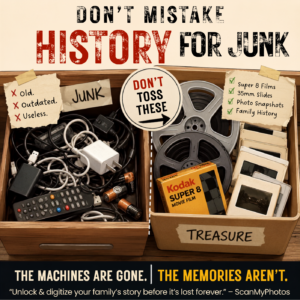
Every home naturally has one—a drawer, closet, cabinet, or garage shelf where all those old gadgets quietly gather. No one ever set out to turn it into a museum; it just happens over time. One charger turns into three, then to twenty. Before you know it, you’re surrounded by mysterious cords, a digital camera missing its battery, an old MP3 player, a Walkman, a flip phone, a VCR cable, an aging remote, and maybe even an eight-track tape that somehow managed to survive every move.
Most of it is clutter. Some of it was once exciting. Some of it was once expensive. Then the plugs changed, the batteries died, the software vanished, and newer devices replaced them. That is what technology does. It moves on.
But somewhere in that same home is another kind of old technology. It may be pushed to the back of a closet or resting in a box no one has opened in years. It may look forgotten, but reels of home movies, boxes of 35mm slides, negatives, and old photographs are not junk. They are family history trapped in Playback Lock.
When the Machine Disappears
According to ScanMyPhotos, Playback Lock happens when the memories are still there, but the devices to see them are no longer around. The story stays alive, but the machine is gone. That’s the difference between an old gadget and a cherished family memory. A broken charger can’t do much because it no longer provides power. But a reel of 8mm film can still bring back memories — it just needs the right machine to do so. A Walkman might be just a nostalgic item, and a box of 35mm slides could be the only visual proof of your childhood, your parents’ younger days, your grandparents’ home, or those family stories everyone’s heard but rarely seen.
The technology expired. The history did not.
The Old Tech That Gains Value
Most technology loses value as it gets older. Nobody gets emotional about old phone chargers. Nobody gathers the family around a missing power adapter. Nobody says, “Thank goodness we kept that cable from 2007.”
Family media is different. Home movies, slides, negatives, and photographs often become more valuable with time. Not because the film changed. Because life changed around it. The baby in the photo became a parent. The young father in the home movie became the grandfather everyone misses. The house in the background was sold. The cousins grew up and moved away. The ordinary backyard birthday party became the last time everyone was together.
Time turns simple pictures into proof. Proof that people were here. Proof that the stories were true. Proof that ordinary days were never ordinary after all.
Here’s how to unlock the old photos, slides, and home movies your family still hasn’t seen.
Not Yet on Your Phone
Modern life makes us think every memory should already be on a screen. Photos live in phones. Videos sit in the cloud. Moments get shared, saved, posted, and searched. But many family memories are still stuck in physical formats that cannot be opened with a tap. An 8mm film reel does not magically become a video on your phone. A 35mm slide does not suddenly appear in your photo library. A negative does not become a picture you can text to your adult children. Those formats need to be unlocked.
That is what digitizing does. It does not change the memory. It releases it from Playback Lock so it can be watched, shared, backed up, and carried forward.
For many families, the first step is simply deciding that the box matters. Once they realize those home movies are not dead technology, ScanMyPhotos.com can help turn old 8mm, Super 8, and 16mm films into digital files that can finally be watched without hunting for a projector that may no longer work.

Tiny Squares, Big Stories
If you have never held a 35mm slide, it can look almost meaningless at first. It is usually a small square cardboard or plastic frame with a tiny color transparency in the middle. Hold it toward a window, and a miniature world appears. A beach trip. A birthday cake. A Christmas tree. A motel swimming pool. A family standing in front of a station wagon. A mother younger than her children can imagine. A father who had no idea this moment would matter someday.
Slides were once family entertainment. People gathered in living rooms while a projector clicked from image to image. The wall became a screen. The family became an audience. The past came alive in color. Now the projector is usually gone. The slides remain. That is Playback Lock.
This is why 35mm slide scanning matters. When families have slides digitized through ScanMyPhotos.com, they are not just converting an old format. They are bringing back the pictures that once lit up the living room wall and making them available for phones, tablets, computers, and family group chats.
The Proof Was in the Box
Every family has stories that get told again and again. Maybe you can tell your children about sleepaway camp. You describe the lake, the cabins, the campfire songs, the counselor everyone loved, the friend you never forgot, and the summer that still feels larger in memory than it probably felt at the time.
Then someone finds the slides.
Imagine yourself beside the lake, holding a canoe paddle and sharing a laugh with friends. You’re standing in front of the cabin, making a silly face at the camera, and feeling the warmth of the moment. Suddenly, your children aren’t just hearing the story—they’re experiencing it through the pictures. That same magic happens when adult children watch old home movies of themselves. You’ve told them about birthday parties, backyard adventures, the dog, cousins, and Christmas mornings when everyone woke up too early. But when they watch the film, the story becomes even more vivid. They see how they moved, how you looked at them, and catch glimpses of relatives they barely remember — brought back to life on screen, if only for a moment.
Playback Lock does not erase family history. It hides it until someone opens it.

Almost Thrown Away
A customer once told us about cleaning out a closet before a move. The usual things were there. Old electronics, cords, broken gadgets, outdated camera cases, and boxes nobody had touched in years. Sitting among them were several reels of home movies.
Nobody had a projector. Nobody knew what was on them. Nobody had watched them in decades. The reels looked no different from everything else in the pile. Old technology. Old stuff. One more thing to unclutter.
They nearly ended up in the trash, but someone took a moment to stop. That small pause ended up saving a piece of the family’s history.
After the films were digitized, the family watched grandparents walking through the backyard, children running across the lawn, birthday candles being blown out, and relatives whose gestures had not been seen in years. What looked like clutter was not clutter. It was a chapter of their lives trapped in Playback Lock.
Old Devices, Living Stories
Technology has a shelf life. Stories do not. Projectors broke. Slide viewers disappeared. VCRs stopped working. Camcorders were replaced. Cables went missing. Formats changed. The memories waited.
That’s why Playback Lock is such a helpful phrase. It offers families a familiar way to identify a problem they already face. The pictures remain. The movies are still there. The story stays intact. The only thing that’s gone is access. And access is so important because a memory that nobody can see is always vulnerable—at risk of being forgotten, misplaced, damaged, or mistaken for clutter.
Unlock the Right Box
Someday, someone will take care of your home. They might find that drawer full of old chargers and mysterious cords, and they’ll recycle what they can and toss what’s no longer useful. But what truly matters is that they’ll appreciate having the home movies preserved and the slides unlocked. They might be thankful that the photos weren’t hidden away in a closet, forgotten over time, because those moments will continue to bring joy to someone special.
That is the lesson of Playback Lock. Old technology is not always the problem. Sometimes the problem is assuming the memory became worthless just because the machine disappeared.
Your family history is not gone. It is waiting. Somewhere in your home, possibly in a box that looks no more important than the clutter around it, are the faces, places, voices, summers, holidays, birthdays, homes, and people who made your life what it is.
Do not throw away the technology that still holds your story.
Unlock it.
Common Questions About Playback Lock (FAQs)
1. What is Playback Lock? Playback Lock is when old home movies, slides, negatives, or photos still exist, but the projector, viewer, camera, or device needed to see them is gone.
2. How can I watch old 8mm or Super 8 films without a projector? The safest way is to have the film professionally digitized, so the movies can be watched on a phone, computer, TV, or shared with family.
3. What should I do with old 35mm slides? Do not throw them away. Slides often hold rare family photos. Scanning them turns those tiny images into digital files you can view, save, and share.
4. Can ScanMyPhotos help unlock Playback Lock? Yes. The photo scanning service digitizes old photos, 35mm slides, negatives, and home movies so families can finally see and share the memories again.
[Revised June 23, 2026].