
Your Phone Warns You. Old Photos Don’t

Your Photos Won’t Warn You
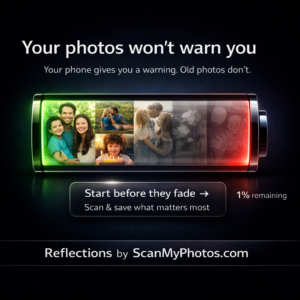
Your phone isn’t the only thing that needs charging, digitizing is how you plug your photos back in.

Think about how your phone works. When the battery gets low, it tells you. You see the percentage drop. You get the warning. And when it hits 1%, you don’t ignore it. You plug it in right away because you know what happens next.

Old printed photos don’t work that way. They don’t send alerts. They don’t flash red. They don’t tell you when they are close to being lost. Instead, the “battery” drains slowly over time, without anyone noticing.

That’s what makes the comparison so real. The “battery” in this case isn’t power. It’s the condition of the photos and the stories attached to them. As years pass, prints fade, colors shift, corners bend, and some photos disappear entirely. Just as important, the meaning behind them starts to fade too. Names get forgotten. Faces become harder to recognize. Moments lose their context.


Your phone isn’t the only thing that needs charging, digitizing is how you “plug” your photos back in.


When people say most photo collections are already at 1%, they don’t mean the photos are gone. They mean they are still here, but no longer safe. Just like a phone at 1%, everything still exists, but it is at risk of shutting down at any time if nothing is done.

That’s why the idea of “plugging them in” matters. For a phone, plugging it in restores the battery. For old photos, digitizing them does the same thing. It preserves what’s left before more fades, gets lost, or becomes impossible to identify. It’s the moment where something fragile becomes protected.

The difference is, your phone tells you when it needs help. Your photos don’t.


Frequently Asked Questions on Photo Scanning (FAQ)

FAQ 1: Why do old printed photos fade over time?

Old printed photos fade because they are constantly affected by time, light, heat, humidity, handling, and storage conditions. Even when they look “fine” sitting in a box or album, the paper, color, and detail can slowly break down over the years. That’s why fading family photos often disappear little by little instead of all at once.


Subscribe for free to digitize your pictures at a reduced price.


FAQ 2: What does “1% remaining” mean for a family photo collection?

“1% remaining” is a way to describe a photo collection that still exists, but is no longer safe. Some photos may already be faded, damaged, missing, or harder to identify. Others may still look okay, but are at risk of being lost over time. Just like a phone battery at 1%, it’s a warning that action should happen now, not later.


FAQ 3: How can I protect old family photos before more is lost?

The best way to protect old printed photos is to digitize them while they are still here to save. Creating high-quality digital copies helps preserve the images, the people, and the stories attached to them before they fade or disappear. Many families use ScanMyPhotos.com to digitize old family photo collections so they can be safely backed up, shared, and passed on.


[Updated March 25, 2026].

Subscribe to Scanmyphotos.com News