
The Photos Everyone Crowds Around at Family Reunions
If you only have a minute: Key takeaways
- Family reunions focus on sharing old photos, which create memorable connections among generations.
- When families prepare photos in advance, they enhance engagement and foster communal storytelling.
- Funny and imperfect photos often evoke the strongest emotions, as they remind people of their past.
- Digitizing photos and creating slideshows can turn memorable moments into shared experiences at reunions.
- The most impactful reunion activities often arise spontaneously, driven by the nostalgic power of sharing family reunion photos.
Estimated reading time: 6 minutes
Every family reunion starts with planning.
Who’s hosting?
Who’s cooking?
Who’s flying in late?
But when people talk about the reunion afterward, none of that is what they remember. They remember the photos. Kiplinger published a widely read story about what actually makes family reunions meaningful. The takeaway was simple and familiar to anyone who has seen it happen in real life.
Best family reunion tips from Richard Eisenberg at Kiplinger.
It’s not the schedule.
It’s not the food.
It’s the old photos.
When Old Photos Appear, Phones Go Down
Something shifts the moment old family photos appear on a TV screen.
Phones stop buzzing.
People lean closer.
Conversations slow down and then deepen.
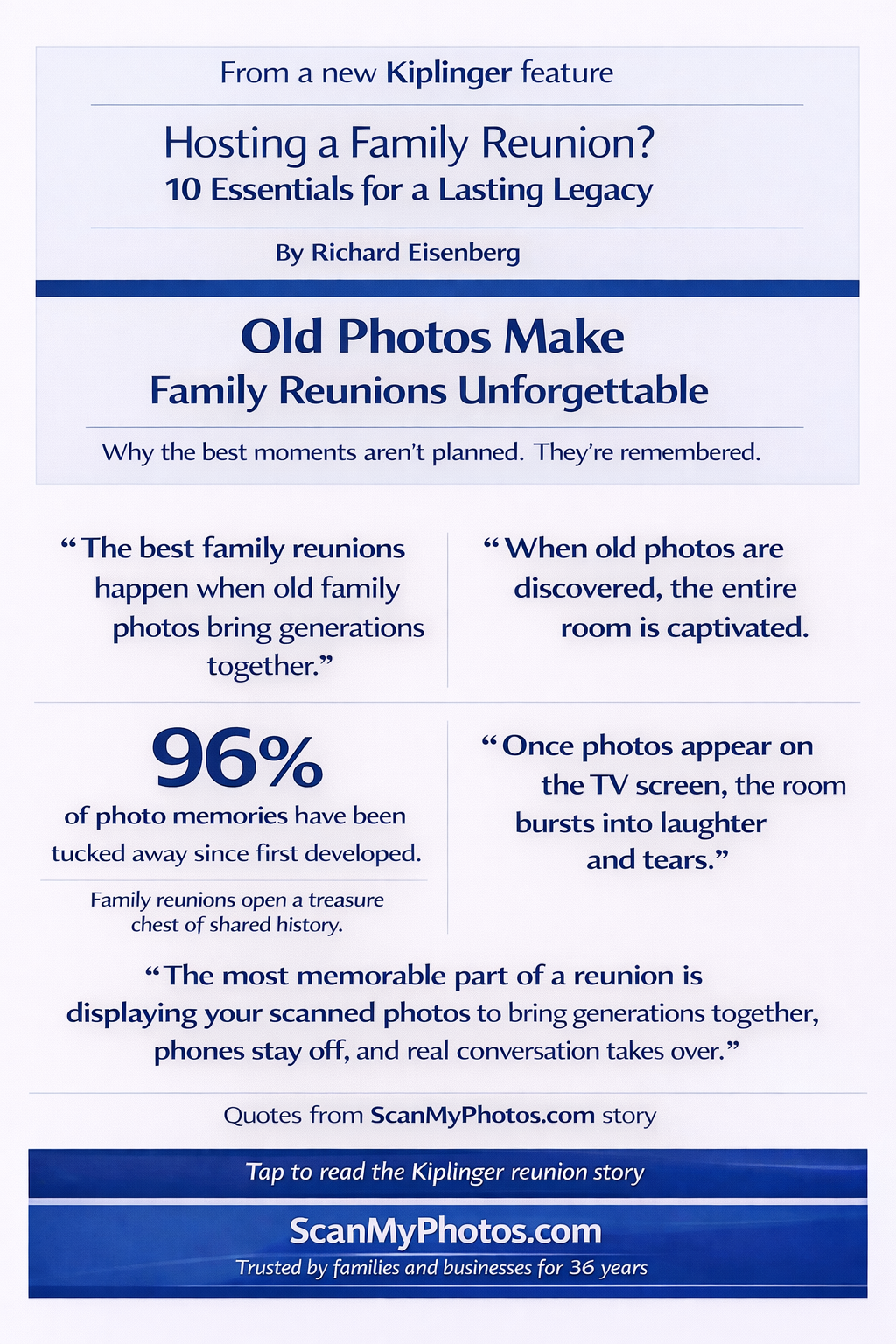
Vintage snapshots, slides, and home movies pull everyone into the same moment. Stories surface that have not been told in decades. Laughter lasts longer. Even the quiet relatives start talking. “The best reunions happen when old family photos guide the conversation,” Mitch Goldstone, chief photo archivist at ScanMyPhotos.com, told Kiplinger.
Photos do something no icebreaker ever can. They give everyone a shared memory to respond to simultaneously.
After 35 years preserving photo history, this stands out: the moments people remember most at a family reunion are rarely on the schedule. Nostalgia does what planning cannot. Old photos have a quiet power to bring every generation together, not as an activity to complete but as a shared experience that pulls phones from hands and replaces them with laughter, surprise, and long-forgotten stories. Research shows that 96% of printed photos have not been seen since the day they were developed, which is why reunions often become the first time families open that history together. When those photos are digitized in advance and played on a TV with familiar music, the atmosphere changes instantly. The conversation starts without prompting because everyone in the room recognizes something on the screen. A childhood moment. A relative no one has mentioned in years. A version of themselves they had forgotten. Old photos work because everyone is already present, and each image gives every age group something real to react to. What begins as organizing pictures becomes something else entirely. People stop scrolling, start pointing, and begin telling stories they did not realize they still remembered. Families think they are managing memories, but what they are actually creating is connection.
The Moment No One Plans Becomes the One Everyone Remembers
This is rarely on the itinerary.
Someone says, “You have to see this one.” Someone else recognizes a face. Another person fills in a story no one else remembered. That spontaneous moment often becomes the highlight of the entire reunion. It works because it includes everyone. Teenagers. Parents. Grandparents. Even relatives meeting for the first time. Photos turn a group of people into a shared experience.
Why Families Are Preparing Photos Before the Reunion
Kiplinger points out that more families are now preparing photos before the reunion begins. Instead of digging through boxes on the day of the event, hosts ask relatives to scan their favorite photos and videos in advance. That includes:
- Printed photos
- 35mm slides
- VHS tapes and home movies
- DVDs and film negatives
For physical media, many families hire a professional to digitize everything properly. According to Kiplinger, families can expect to pay $50 to scan 250 photos [with free return S/H].
Why the Funny Photos Matter Most
Once photos are digitized, families usually create a simple slideshow or short video set to music. The goal is not perfection. “The goofy and silly ones are the ones that get the tears and the laughs,” Goldstone explains.
Those imperfect photos spark the strongest reactions because they feel real. They remind people who they were before life got busy.

The Simple Next Step Most Families Miss
Here is where many reunions fall short. Families love the idea of sharing photos, but they wait until the last minute. Boxes stay closed. Tapes stay unwatched. The families that get the most out of this moment do one small thing differently. They start early.
They ask everyone to contribute.
They get everything digitized.
They reuse and add more for every reunion, holiday, and family gathering after that. The photos stop being items in storage and start becoming part of family life again.
Why This Works Better Than Any Planned Activity
Schedules fade.
Menus are forgotten.
Decorations get packed away. But seeing your family history together leaves a mark. The most memorable part of a reunion is often the one that brings generations together, keeps phones off, and lets real conversation take over. Sometimes the best reunion activity is not something you plan. It is something you remember. Ready to rescue your own photos?
Frequently Asked Questions About Family Reunions
What actually makes a family reunion memorable? The moments people remember most are rarely planned. Sharing old family photos and home movies brings everyone into the same conversation at the same time. Phones go down, stories surface, and generations connect in a way activities and schedules rarely achieve.
What is one simple thing hosts can do to improve a family reunion? Ask relatives to prepare photos in advance. When favorite pictures, slides, or home movies are digitized in advance, hosts can create a simple slideshow or video that becomes a shared experience for everyone. It removes awkward downtime and gives the reunion an emotional center.
How should families scan old photos and home movies before a reunion? Families can scan small batches themselves, but for larger collections, many choose a professional service. Kiplinger notes that scanning 250 photos costs $50 with free S/H. Services like ScanMyPhotos.com specialize in digitizing prints, slides, and home movies so families can watch and share their history together on one screen.
[Updated February 10, 2026].