How a Photo Retailer Survived the Digital Revolution
From 27-minute film processing to preserving millions of family memories, the story of a neighborhood photo lab that found a new future.
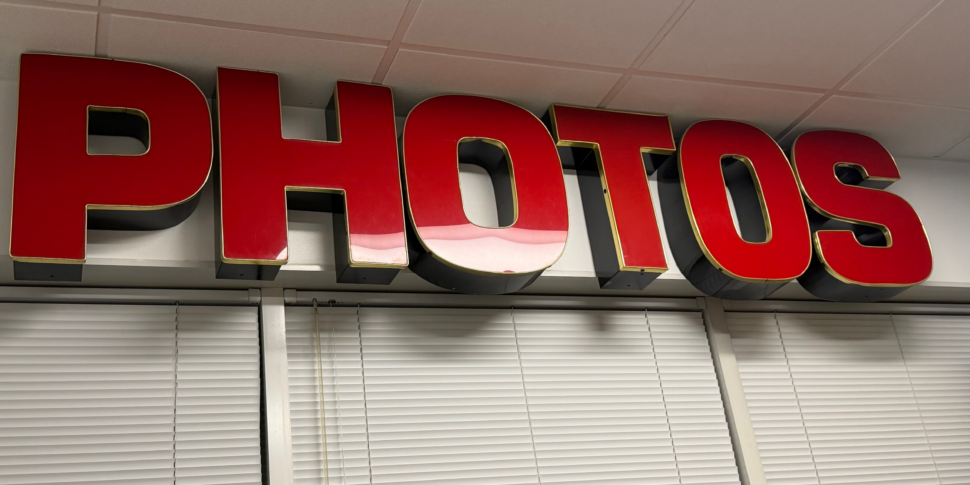
There’s a sign in my office that reads PHOTOS. It’s the only word I kept from the original storefront sign at 30 Minute Photos Etc., the retail photo lab Carl Berman and I opened in Irvine, California, in September 1990. The plastic letters glowed with neon. Thirty-six years later, that one word still has a place in my office. Our store was in a shopping center at Jamboree Road and Barranca Parkway, about a two minute walk from where ScanMyPhotos is headquartered today. Back then, one hour photo labs were everywhere. Fotomat, Ritz Camera, Fox Photo, Moto Photo, and countless independent stores were part of everyday life. People dropped off rolls of film, went shopping, then returned to pick up envelopes filled with pictures they hadn’t seen yet.
Whatever happened to all those photo labs? Digital cameras made film processing unnecessary for most people. As customers stopped buying film, the neighborhood labs that depended on processing it began disappearing. Some owners adapted. Others closed their doors. Our little store found a completely different future.
Our First Big Gamble Was in the Yellow Pages
In 1990, finding a great retail location was highly competitive. We were lucky to find ours, though we nearly committed to a full year of advertising before we even had a store. Back then, customers found local businesses through the Yellow Pages. They’d open those enormous telephone directories, look under photo processing, and choose a store. I wanted us to have the biggest ad in the category. The challenge was that the advertising deadline came before we’d signed our lease, and the directory only came out once a year. If we missed the deadline, we’d have to wait for the next edition. Carl and I had already ordered our processing equipment, but we still didn’t have a confirmed delivery location. I went ahead and signed the advertising contract, taking on a substantial monthly expense before we knew whether we’d get the storefront. Thankfully, we signed the lease just a few days later.
For years, we bought the largest Yellow Pages ads we could afford. We used white knockout lettering against dark backgrounds, then experimented with color when it became available. Today, we can change ads in seconds. Back then, we approved the proofs and lived with our decisions for an entire year. Over the years, some of our favorite vendors would profile what we built, including MIVA and Stamps.com
The Magic of 27 Minutes
Before opening, I spent a week training at Noritsu’s American headquarters in Buena Park, near Knott’s Berry Farm. Noritsu helped create the modern one hour photo industry when it introduced its Quick Service System minilab in 1976. Retailers could develop film and make prints inside their own stores instead of sending everything to a central processing facility. Our equipment could typically process a roll of film in about 27 minutes. That’s where the name 30 Minute Photos Etc. came from. When competitors promised one hour service, we could offer customers their pictures in roughly half that time.
The machines could be quite complex, so we needed to understand film chemistry, photographic paper, silver recovery systems, mechanical components, and maintenance. We also had to monitor temperatures, replenish chemicals, and check prints for color accuracy with an expensive densitometer. Having Noritsu nearby was a huge convenience. If a machine needed a replacement part, we could simply drive to Buena Park and pick it up ourselves.
I’ve always found that location interesting. We were learning what seemed like the future of photography just down the road from Knott’s Berry Farm’s Ghost Town, an attraction devoted to recreating old mining communities. Those towns were once built around thriving industries that eventually disappeared. I wonder how many of today’s photo apps will someday become the next Ghost Town.
Life Behind the Photo Lab Counter
Customers typically brought in Kodak film with 24 or 36 exposures. We developed the negatives using the C-41 chemical process, then printed the pictures onto Kodak photographic paper using the RA-4 process. About half an hour later, customers returned to discover what they’d photographed. Some ordered extra prints for relatives. Others wanted enlargements of a favorite picture. The photo industry was surprisingly close-knit. Although we competed for customers, many lab owners knew one another. We exchanged ideas, discussed equipment, and shared marketing strategies. There was always somebody experimenting with something new.
We tried plenty of ideas ourselves. Kodak introduced self-service enlargement equipment that let customers insert strips of 35mm negatives into a machine. A small monitor displayed the positive image, making it easy to choose pictures for larger prints. Later, we invested in banks of digital photo kiosks where customers could design their own prints, create scrapbook pages, and order enlargements. I wanted people to enjoy spending more time in our store, so we placed elegant glass bottles of Voss water beside the kiosks, along with candy bars. The tall, clear bottles looked like something you might find in a nice hotel. It was a small touch, but I liked the idea of making a neighborhood photo lab feel a little more special.
Red Leather Chairs and a $100,000 Makeover
In 2006, Carl and I spent approximately $100,000 renovating the store. We installed six digital photo kiosks, brought in red leather chairs, and updated the interior. The Orange County Register covered the makeover in an article titled Putting a Fresh Face Forward. We also purchased a high-speed photo scanning machine for roughly $60,000, an investment that would eventually become central to our business.
Our lab had already drawn media attention well before the renovation. The Wall Street Journal even featured us, and in October 1993, the Los Angeles Times highlighted the privacy protections we offered our customers, including celebrities. Our employees signed confidentiality agreements, kept finished photographs out of public view, and securely shredded rejected prints. We also advertised in gay and lesbian publications, connected with entertainment industry customers, and offered convenient mail-in processing services.
People trusted us with their personal photographs. Protecting that privacy was important.
News coverage: Los Angeles Times, October 10, 1993, Photo Processor to the Stars Focuses on Developing Privacy
Later that month, devastating wildfires struck Southern California. We offered free photographic reproduction services for pictures damaged by fire or water. The Los Angeles Times included our lab among the businesses helping affected families. News coverage: Los Angeles Times, October 29, 1993, Orange County fire recovery resources
In 2005, we launched Operation Photo, collecting digital cameras for military families so they could share pictures with loved ones serving overseas. News coverage: Shutterbug, 2005, Digital Cameras for a Good Cause
Our small business also became involved in a much larger legal fight over credit card fees. When Visa and MasterCard increased the fees merchants paid, we challenged those practices. Our company became lead plaintiff in litigation against the card networks, which settled for over $5 billion and benefited millions of merchants nationwide.
When Customers Stopped Bringing in Film
The first digital cameras weren’t especially impressive. Photos could look quite pixelated, particularly when enlarged. Still, people loved seeing their pictures right away. They could take hundreds of photos without buying film or paying for processing or prints. For traditional photo labs, though, the economics were getting tougher. Equipment, rent, supplies, and staffing still cost money, even as fewer customers brought in film. Across America, familiar photo businesses began to disappear. Fotomat’s parking-lot kiosks had largely vanished, Ritz Camera was struggling, and other chains were changing how they operated or closing locations.
We began experimenting with the consumer internet. Customers could order photographic reprints and enlargements from their computers, including 8 by 10 prints, which we’d ship directly to them. Some days we’d receive one or two orders, perhaps $10 or $20 in revenue. It hardly seemed worth the effort, but we were learning how to serve people who lived nowhere near Irvine. Meanwhile, millions of families already owned something that digital cameras couldn’t replace: decades of printed photographs, slides and negatives. Those pictures sat in drawers, cabinets, boxes, and storage bins. Many people wanted digital copies, but scanning thousands of photographs individually was an enormous job.
We had the equipment to handle large collections. We also understood photographic materials and had experience shipping orders across the country. ScanMyPhotos became our new direction. Inc. Magazine even reported on the branding name.
The New York Times Article That Changed Our Business
On August 14, 2008, David Pogue wrote about our bulk photo scanning service in The New York Times. His article was titled Your Photos, Off the Shelf at Last. We have been trying to build an online business for years. I had no idea what was about to happen. Customers across America began requesting our shipping boxes, filling them with photographs and mailing them back to Irvine. The orders arrived faster than we could make room for them. Our store was only 1,200 square feet, and before long, boxes covered roughly half the floor.
As more shipments arrived, we stacked them wherever we could. Soon, our small team was walking across two layers of tightly packed boxes, with almost no room to step. The boxes were packed so tightly they felt like bricks. It was quite a sight, though not exactly an ideal setup for running a photo-scanning operation. We knew it was time to move. Within weeks of the article’s publication, we expanded into a larger headquarters and welcomed additional employees. The Yellow Pages had once connected us with customers in nearby neighborhoods; now, families thousands of miles away were sending us their photographs.
Years later, the CBS Evening News stopped by to profile two of our customers who were racing to protect their archives from natural disasters.

Whatever Happened to the Other Photo Lab Owners?
I often wonder what happened to the thousands of independent photo lab owners who spent years building businesses around film processing. Many of us invested heavily in equipment, signed leases, trained employees, and worked long hours serving our neighborhoods. Some owners moved into digital printing. Others sold their stores, retired, or found entirely different careers. I’d love to hear from anyone who owned or worked at one of those labs. What was your store called? Where was it located? What happened when customers stopped bringing in film? There must be some fascinating stories about how people handled those changes.
Today, ScanMyPhotos.com is still in Irvine, just a short walk from our original 30 Minute Photos Etc. location. We no longer develop film in 27 minutes. Instead, we digitize prints, slides, and negatives. Now, we digitize two printed pictures each second.
I still have the word PHOTOS from our old storefront sign displayed in my office. It’s a small reminder of where we started.
I’m glad I kept it.
Revised on October 14, 2026