
Technology should make people better at their jobs, not make people disappear
Key Takeaways
- The article argues that businesses should emphasize that ‘Humans Still Work Here’ to counteract fears of AI replacing human jobs.
- It highlights the importance of real people in customer service, even as technology improves efficiency.
- While AI can boost productivity, customers still want access to human agents, with 87% saying so in a recent survey.
- Job creation matters more than layoffs, as many potential jobs go unfilled when AI is overused, particularly among young workers.
- The author suggests that companies should communicate their human presence to build trust and improve customer experience.
Estimated reading time: 6 minutes
By Mitch Goldstone, Chief Photo Archivist, ScanMyPhotos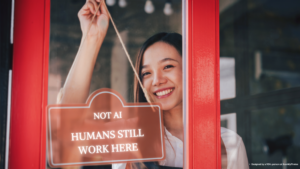
I’ve been thinking about a message I’d like to see more businesses say plainly: HUMANS STILL WORK HERE. Not just in a store window. Put it on the website, near the order button, in customer service or wherever people might wonder whether there’s still a person on the other side. With so much talk about AI replacing human jobs, maybe telling customers that people still work here is about to become something worth bragging about.
A few years ago, that would have sounded ridiculous. Of course people worked there. Who else would? Today, I’m not so sure.
I’m not against AI. I run a technology business. When we started in the photo industry in 1990, people brought us rolls of film. We developed them, made prints, and handed them back in an envelope. Then digital photography arrived and changed almost everything. We changed too. At ScanMyPhotos.com, technology now lets us digitize old photographs, slides, and negatives at a scale that would have been impossible when we started.
But people still do the work. Real people receive the photographs. Real people handle them. Real people scan them. Real people step in when something needs attention. That matters even though most of our customers never walk through a front door or stand at a counter. They order online, ship us their pictures and also trust that actual people are there when those pictures arrive.
That is the part of modern business I think deserves more attention.
There’s a difference between using technology to help someone do a better job and using technology mainly because you no longer want to employ that person. We’re starting to feel that difference everywhere, especially online. You place an order and have a question. You open the chat box. You explain the problem. A bot gives you an answer that doesn’t fit. You try another question. Then you start hunting through a website for a phone number or a way to reach somebody who can actually understand what happened.
“Everyone is worried about AI killing jobs. She’s testing a fix-it plan.” Shira Ovide at The Washington Post reports on former Commerce Secretary Gina Raimondo’s bipartisan effort to test ways to protect workers as AI changes employment.
Customers are noticing. In a 2026 survey, Gartner found that 87 percent of customers said companies using generative AI for customer service still need to provide access to a human agent. Half also said generative AI had made customer service easier. That tells me people aren’t necessarily rejecting AI. They just don’t want the human option erased. Gartner research
The bigger issue may be jobs. Pew Research Center reported that 71 percent of American adults believe AI will lead to fewer jobs in the United States over the next 20 years. Maybe they’re right. Maybe they’re wrong. Technology has surprised us before. Pew Research Center
What caught my attention was recent research from Stanford’s Digital Economy Lab. Researchers found that employment among workers ages 22 to 25 in occupations highly exposed to AI was about 19 percent below where it would have been if it had kept pace with less exposed jobs. Even more interesting, the change appears to be happening mainly through reduced hiring, not mass layoffs. Stanford Digital Economy Lab. That part has stayed with me. A job that disappears is easy to see. A job that is never created is almost invisible. There’s no layoff announcement. Nobody walks out carrying a box. A company simply decides it needs six people instead of ten. We may never know the other four jobs were ever possible.
At ScanMyPhotos, technology helps us work better, but real people still handle and scan your photos.
Consumers already make choices based on more than price. We support local businesses. We go back to independent restaurants because we want them to survive. We choose one company over another because we like what it stands for. Online shopping should be no different.
Imagine two websites selling roughly the same thing at roughly the same price. One has automated almost every human out of the experience. The other uses plenty of technology but makes it clear that real people still answer questions, handle orders, solve problems, and take responsibility when something goes wrong.
I know which one I’d trust more.
That is why I think HUMANS STILL WORK HERE could become more than a sign in a window. It could be a line on an e-commerce site, in an order confirmation, near a customer service button, or somewhere else a business wants to tell people: yes, we use modern technology, but there are still people here.
This isn’t about stopping AI. That would be pointless. It’s about deciding what we want AI to do for us. The best technology should make people better at their jobs, remove tedious work and also help businesses serve customers better. I don’t think success should automatically be measured by how many people we can remove from the process.
I’ve spent most of my career watching technology remake an industry. You adapt or disappear. But adapting doesn’t mean we should celebrate every time another human being disappears from the equation. Sometimes I want the machine. Sometimes I want the person. When I order online, I’d just like to know the person is still there.
FAQs on Keeping Business Human
AI can make service faster and easier, but customers still want access to a real person when something goes wrong, a question is unusual or trust matters. The strongest businesses may be the ones that use AI without making people unreachable.
Not necessarily. Research suggests many customers appreciate what AI can do, but they don’t want it to completely replace human help. The issue isn’t AI itself. It’s whether businesses remove the human option.
It means technology is being used to help employees do better work, while real people still answer questions, handle orders, solve problems and take responsibility. It’s a simple trust signal that may become increasingly valuable as more business interactions become automated.