Shift your focus from just networking to being truly memorable, because those first few seconds are your best chance to make a lasting impression.
Key Takeaways
- Focus on making a memorable impression rather than just exchanging business cards.
- Genuine connections matter more; memorable interactions leave lasting impacts.
- Mark Cuban taught the lesson that a business card is not a true introduction.
- People remember feelings and surprising moments more than they do with traditional networking techniques.
- Aim to engage meaningfully in 20 seconds rather than handing out cards.
Estimated reading time: 6 minutes
When it comes to how to be memorable, the best introductions do not end with a business card. They end with someone still thinking about you after you walk away.
Mark Cuban once told me, “I don’t do business cards,” and those five words became a valuable lesson for me. They taught me more about genuine networking than all the badge scans, trade show follow-ups, LinkedIn invites, and glossy little rectangles I’ve handed out over the years. I want to share this lesson with you, hoping it helps you leave a memorable impression at business events or anyplace else you encounter new people.
It happened at CES in Las Vegas on Jan 7, 2016. I was walking through Eureka Park, the startup section where people show off inventions that look like they were built on no sleep, cold coffee, and dangerous levels of confidence. That is where I literally ran into Mark Cuban.
Mr. Cuban is the billionaire entrepreneur, investor, and longtime “Shark Tank” star. He has heard more pitches than most of us have heard leaf blowers on a Saturday morning. He had just stopped at one of the first spinning LED display exhibits. You know the kind. A fast-moving light device that makes pictures and words float in midair. It looks like a hologram, a magic trick, and a Vegas fever dream all at once.
I could tell he was intrigued. As he left the booth, I knew I had seconds. Not minutes. Seconds. So I skipped the warm-up act. I asked him if all his vintage family photos had been digitized. Then I showed him an 18-second video of how fast ScanMyPhotos.com digitizes pictures.
For one tiny moment, it worked. He looked interested. Then I panicked and did what people do when they think paper can rescue a moment. I handed him my business card. The hope was that he would check out ScanMyPhotos and entrust us to digitize his history of photos, slides, and home movie reels. Then, it went south. He smiled, politely, and said, “I don’t do business cards.” Then he was gone. Almost as fast as we scan photos.
At the time, I thought I had lost the opportunity. Looking back, I think I got the lesson. A business card is not an introduction. It is a tiny homework assignment you give someone who never asked for homework. Here is my name. Here is my company. Here is my email. Here is my phone number. Please stop your life later and remember why this mattered. That is a lot to ask from someone who has already met 400 people before lunch.
This week, I saw the same lesson again. I met Joanna Stern at a Live Talks Los Angeles event with John Coogan. It was a conversation about artificial intelligence, in which she shared insights from her best-selling book, I Am Not a Robot. Joanna is my favorite tech journalist. Her book, “I Am Not a Robot,” is about technology, AI, and what still makes us human. That is also what makes her work so good. She can take confusing tech noise and make it feel like something real people can understand.
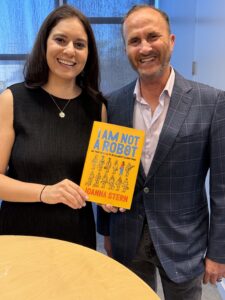
Before her presentation, I spent a few minutes with her, one-on-one. I told her something I meant. “You were AI before OpenAI.” She looked surprised and asked, “What do you mean?”
I told her that before everyone was talking about AI tools, she was already doing what the best technology promises. As a top journalist, she could take a mountain of jargon, product specs, publicist-speak, corporate fog, and weird tech claims and turn them into something clear, funny, useful, and human for her (former) Wall Street Journal column. She is now NBC News’ senior technology correspondent and creator of “New Things,” a platform and community focused on making technology, AI, gadgets, and digital life feel understandable, useful, and human.
She smiled and said, “I never thought of it that way.” That was the moment. Not a pitch. Not a card. Not a forced follow-up. Just a real observation that made someone pause. I also explained that analog photos are invisible to AI and chatbots — they must be digitized to get uploaded.
Later, as her presentation was about to begin, I noticed a business card sitting on the table where she was signing books. Someone had done exactly what I did with Mark Cuban.
And I get it. We all do it. You meet someone impressive. Your brain starts sprinting. You want to be remembered. You want one more chance. So you hand over a card and hope that little rectangle somehow carries the magic you did not create in the moment. But seriously, what is she supposed to do? Stop everything, pick up the card, gasp, and say, “This is it. Cancel the event. Alert NBC.” That is not how people remember people. And on that table, as she walked away, was that card, seconds from being tossed.
People remember feelings. They remember surprise. They remember a line they did not expect. They remember being seen in a way that felt true.

At CES, companies scan badges as if they were collecting treasure. Exhibitors grab cards. Attendees trade contact info. Everyone leaves with databases full of people they will probably never truly contact again. After 36 years of attending the consumer electronics tech convention (and every other), I can count on one hand the number of badge scans and business cards that turned into something real.
The conversations mattered. The cards mostly became tiny paper souvenirs of almost. The lesson is simple. If you have 20 seconds, the length of an ‘elevator pitch’ with someone important, do not spend it setting up a reminder for later. Make the moment matter now. Say something useful. Say something true. Say something they have not heard all day. Ask the question that makes them stop walking. Notice the thing everyone else missed.
Because the goal is not to hand someone your information. The goal is to become the person they remember without needing the card.
And if that does not work? Well, there is always the business card — probably resting peacefully in a trash can somewhere nearby.

[Revised May 21, 2026].
Why business cards fail: networking tips, memorable introduction, elevator pitch, personal branding, CES networking, how to stand out, business card alternatives. #Networking #CES #MarkCuban #JoannaStern