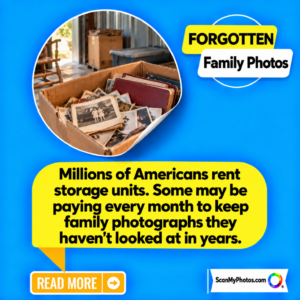
Do you have photos like this?
Key Takeaways
- Many people have old photos and artifacts that can document personal history, yet they often underestimate their value.
- Museums and historical groups seek public contributions to preserve local history captured in everyday moments.
- Digitizing old photographs protects them from degradation while allowing families to maintain ownership and share materials with institutions.
- Professional scanning services enable families to create high-quality digital copies of their photos for donations without losing the originals.
- It’s crucial to digitize materials promptly; once they’re gone, no institution can recover them, underscoring the importance of preserving personal history.
Estimated reading time: 5 minutes
 It sits on a closet shelf or under a bed. Inside are photographs, letters, postcards, maybe a ribbon or a program from a long-ago event. Nothing inside looks important at first glance. Taken together, it is a record of a place, a time, and a way of life that no one else can replicate.
That is why so many people are asking the same question right now. What should I do with my old photos and artifacts before they disappear?
When personal memories become public history
Museums, libraries, and historical groups across the country are increasingly inviting the public to share what they have tucked away at home. Not to take ownership. Not to pressure anyone. Simply to learn what exists and to preserve copies of it before time does what time always does.
Most local history comes from unofficial archives. It came from families. From snapshots taken on porches. From photos of small businesses, boats, streets, celebrations, uniforms, holidays, and everyday routines that never made the newspaper. These images explain how people actually lived, not how history books summarize it.
The surprising part is how often families assume their materials are not useful. In reality, the most ordinary images often matter the most. A street corner before it changed. A workplace before it closed. A holiday tradition that no longer exists. These moments fill in gaps that institutions cannot reconstruct on their own.
Why waiting carries real risk
Old photographs and paper artifacts are fragile, even when they look fine. Color fades. Paper becomes brittle. Adhesives fail. Labels fall off. Names are forgotten. Once the story behind an item is lost, the object becomes harder to place and easier to lose. The first step is to digitize the pictures, slides, film negatives, and old home movies.
There is also a very practical risk. Many families are downsizing. Homes are being cleared quickly. Boxes are thrown away not because they are unwanted, but because no one has time to sort them properly. History disappears in ordinary cleanup moments.
Digitizing materials early changes that outcome. It creates a stable record that can be shared, copied, studied, and preserved without risking the original item. It also gives families something they can keep even if the physical object eventually degrades.
How to get your pictures digitized for donating to historical societies.
How scanning fits into modern preservation
Professional scanning captures photos in high-quality JPEG or TIFF files while keeping the originals safe at home. Digital files can be shared with museums, historical societies, or community projects without surrendering ownership. Families remain in control, while institutions gain access to visual history that would otherwise be lost.
This approach also allows a single item to serve multiple purposes. A scanned photo can support a local exhibit, appear in a publication, be shared with relatives, and be preserved for future generations all at once.
ScanMyPhotos is a long-standing photo digitization service trusted by families and organizations for decades.
A broader shift in how history is saved
What is changing right now is not just technology. It is awareness. People are realizing that history does not only live in museums. It lives in closets, albums, envelopes, and shoeboxes. Once those materials are digitized, they become accessible again rather than hidden.
If you have old photos or artifacts, the most important step is not deciding where they belong. It is making sure they survive long enough to be considered at all. Because once they are gone, no exhibit, archive, or institution can bring them back.

Donating Photos Frequently Asked Questions
Should I donate original photos to a museum or keep them? Most museums prefer digital copies rather than originals. Keeping the originals protects your family history while still allowing institutions to study and share the images.
Why do museums ask the public for old photos and artifacts? Local history often exists only in personal collections. Everyday photos of homes, businesses, events, and people fill gaps that official records never captured.
Is it better to digitize photos before sharing them with a museum? Yes. Digitizing preserves image quality, names, and context while allowing you to share copies widely without risking damage or loss to the originals.
What is the safest way to digitize photos before donating copies? Many use professional services such as ScanMyPhotos.com to create high-resolution digital files they can share with museums while keeping the originals safe at home.
Donating Photos Frequently Asked Questions
Should I donate original photos to a museum or keep them? Most museums prefer digital copies rather than originals. Keeping the originals protects your family history while still allowing institutions to study and share the images.
Why do museums ask the public for old photos and artifacts? Local history often exists only in personal collections. Everyday photos of homes, businesses, events, and people fill gaps that official records never captured.
Is it better to digitize photos before sharing them with a museum? Yes. Digitizing preserves image quality, names, and context while allowing you to share copies widely without risking damage or loss to the originals.
What is the safest way to digitize photos before donating copies? Many use professional services such as ScanMyPhotos.com to create high-resolution digital files they can share with museums while keeping the originals safe at home.
[Revised on February 4, 2026].