
Who Gets the Family Photos When Someone Dies and Why It’s Rarely Decided Clearly
Key Takeaways
- Estate planning often overlooks family photos, leading to confusion about their distribution after death.
- Unlike other assets, photographs hold emotional value that complicates their ownership and distribution among family members.
- Digitizing photos before a loved one’s passing can increase access and reduce tensions surrounding inheritance decisions.
- Families frequently postpone discussions about photos, which can lead to regret and unresolved conflicts later on.
- Ultimately, the question of who gets the photos often reflects deeper concerns about memory, remembrance, and shared history.
Estimated reading time: 6 minutes
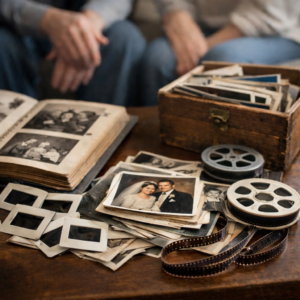 No one brings it up at the beginning.
Estate planning conversations tend to start with certainty. The house. The accounts. The paperwork that promises order at a moment when life feels anything but orderly. People want clarity. They want fairness. They want to know they are doing this the right way.
And then, often near the end, someone pauses.
“What about the photos?”
The question lands differently. The room shifts. What had been a practical discussion becomes something else entirely.
Family photographs do not behave like other belongings. They are not interchangeable. They do not divide neatly. A single image can hold different meanings for each person in the room, and sometimes for reasons that are hard to explain out loud.
They carry faces that no longer age, gestures that no one remembers noticing at the time, moments that once felt ordinary and now feel essential.
An Afterthought That Rarely Is
Despite their emotional weight, family photos are rarely addressed directly in estate plans. Wills are specific about financial assets and surprisingly vague about memory. Photographs are often grouped with household contents, a legal catchall that fails to capture what they represent.
As a result, photos tend to follow logistics rather than intention. They go to the person who lives closest. Or the one who handles the clean-out. Or the sibling who volunteers to take the boxes simply because someone has to.
It is rarely a conscious decision. It is just what happens.
Later, questions surface. A brother wonders where the albums went. A sister realizes she no longer has access to photos from her childhood. No one wants to sound territorial. No one wants to reopen grief. And so the discomfort settles quietly.
“I thought I was being responsible,” said Marianne, a retired teacher in Fort Collins, Colorado, who took the family albums after her parents died. “It wasn’t until years later that my sister told me she felt like something had been taken from her. I honestly hadn’t seen it that way.”
Ownership, Access, and Rights Are Not the Same Thing
Legally, photographs are personal property. The physical prints or albums typically pass to the person who inherits them under a will, trust, or state law. But ownership of the object is not the same as ownership of the image itself.
When it exists, copyright usually belongs to the person who took the photograph, not the people in it. In many older family collections, that photographer may be long gone, unknown, or never formally documented. In practice, families rarely consider copyright when sharing personal photos, yet the distinction matters.
What one person legally owns may still feel, to others, like shared history. Possession does not automatically grant moral authority over access, copying, or use. And the law offers little guidance on how families should navigate that emotional terrain.
This gap between legal rights and emotional expectations is where misunderstandings tend to grow.
When the Question Becomes More Than Legal
A wedding photograph may belong, in equal measure, to the people in it, the people who paid for it, and the children who grew up seeing it framed on a wall. Childhood photos do not feel owned so much as shared. When access disappears, the loss feels personal, even if no harm was intended.
This is why photographs so often outlast other inheritance disputes. They are more about visibility than about value. Less about possession than participation.
A Shift Families Are Beginning to Make
Some families are approaching the problem differently, not by trying to divide photographs more carefully, but by loosening the idea of possession altogether.
Digitization has changed the stakes. When photos are scanned and shared before a passing, access expands. The pressure to control the physical originals diminishes. What matters is no longer who holds the box, but who can see the image.
For many families, that shift alone is enough to ease long-standing unease.
“When we finally digitized my parents’ photos, the anxiety just fell away,” said Luis, a software consultant in San Marcos, Texas. “Once everyone had the pictures, the albums themselves stopped feeling like leverage.”
The Conversations That Come Too Late
The hardest time to decide what to do with photographs is after a loss. Grief narrows attention. Sorting feels overwhelming. Small disagreements feel larger than they are.
Handled earlier, photographs can become a shared project rather than a silent source of tension. Stories can be told while the people who know them are still alive. Names can be written down before they fade. The act of preservation becomes collaborative instead of corrective.
Yet many families postpone these conversations because they seem emotionally fraught, or because photographs feel less urgent than financial matters. It is an understandable impulse. It is also why regrets around photos tend to linger.
What the Question Is Really Asking
When people ask who gets the photos, they are rarely asking about ownership in a strict sense.
They are asking who gets to remember. Who gets to revisit? Who gets to carry the story forward?
Handled with care, photographs can remain what they were meant to be. Not trophies to be claimed, but touchstones shared across generations. When everything is digitized, it is easy to make sure everyone receives those memories equally.

Frequently Asked Questions
FAQ 1: Who gets family photos after someone dies? Unless family photos are specifically addressed in a will or trust, they usually go to whoever inherits household contents or clears the home. In practice, this often happens by default rather than by design, which is why photos frequently become a source of regret or conflict later.
FAQ 2: Who owns the rights to old family photos? The physical photos belong to whoever legally inherits them, but copyright usually belongs to the photographer. For many older family photos, the photographer is unknown or deceased, so families typically focus on access and sharing rather than strict legal rights.
FAQ 3: What should families do with photos before dividing an estate? Most estate planners recommend digitizing family photos first so everyone has access. Scanning services like ScanMyPhotos make it possible to preserve and share images before decisions about physical albums create tension or loss.
[Revised January 28, 2026].