
Key Takeaways
- The key to lasting business trust lies in who companies listen to and how quickly they respond.
- Like fighter pilots, customers sense risks before companies do, making it crucial for businesses to listen actively.
- Successful companies prioritize customer-first leadership by acknowledging concerns promptly and without defensiveness.
- Building trust involves immediate action over explanations, as customers value empathy more than policy.
- Trust, once established, leads to stronger relationships and long-term success in customer-first leadership.
Estimated reading time: 5 minutes
The Business Lesson Hidden Inside a Fighter Jet

If you’ve ever wondered why some companies earn lasting trust while others quietly lose it, the answer often comes down to one thing: who they listen to, and how fast.
A fighter pilot once shared a rule he gave to the person sitting next to him, the co-pilot, in a two-seat jet. “If I ever yell EJECT, don’t ask why. Don’t hesitate. Pull the handle, or you’ll be talking to yourself.” It is a stark instruction. There is no debate built into it, no explanation offered in advance, no reassurance. Just an explicit acknowledgment of how quickly things can go wrong at altitude, and how dangerous hesitation becomes when seconds matter.
Most people hear this story and assume it is about authority. It is not. It is about trust, responsibility, and timing. In the cockpit, the pilot sees information that the co-pilot cannot. Speed. Altitude. Subtle mechanical signals. By the time danger becomes evident to everyone, the window to act may already be closing. Survival depends on listening without delay, not on understanding every detail in the moment.
What Enduring Companies Understand About Listening
That lesson does not belong only to aviation. In business, the roles quietly reverse. The customer becomes the pilot. Customers sense risk before companies do. They know when something matters deeply, when something feels fragile, when the stakes are higher than usual. Often, it shows up in ordinary ways. An email that sounds more careful than usual. A pause before a decision. A sentence that begins with, “I just want to be sure…”
Those moments about customer-first leadership are easy to talk past.
Many businesses do. They explain policies. They defend decisions. They slow things down with process and reassurance. The reply comes a little late. The concern gets rationalized away. The moment passes. And with it, a small piece of trust.

The Customer Is the Pilot
The businesses that endure understand something both simple and challenging. Leadership is not about control. It is about recognizing who sees the risk first and responding without ego. This matters most when what is being entrusted cannot be replaced.
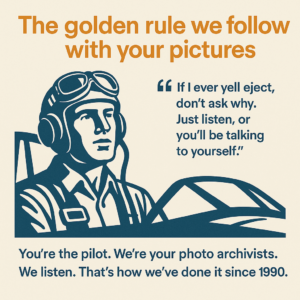 Photographs are an example. They look ordinary until they are not. A faded print. A fragile negative. A single image that holds an entire chapter of someone’s life. When people hand those things over, they are not looking for clever explanations or confident promises. They are looking for care. When someone says, “This matters to me,” they are not asking for permission. They are calling for attention.
The most resilient businesses learn to hear that instantly. Not because it sounds noble, but because it works. That way of operating is learned over time, through repetition, through listening thousands of times, and through understanding that trust is built in moments that feel small but are not. It is why some companies quietly last for decades while others burn bright and disappear. Not because they were louder. Not because they moved faster. But because they understood who was really flying the jet.
The lesson is not dramatic. It is not trendy. It is not new. When the customer speaks, stop talking. Start listening. Act with care. That rule has guided everything at ScanMyPhotos for more than 35 years. And it still works, because trust, once earned, asks only one thing in return: that you listen when it matters most.
Frequently Asked Customer Service Questions (FAQs)
What are the most important customer service best practices today? The most important practice is listening quickly and without defensiveness. Customers often signal concern before a problem becomes obvious. Businesses that respond with attention and action, rather than explanation, build stronger trust and longer relationships.
Why do customers feel unheard by companies? Customers often feel unheard when businesses prioritize policy, process, or speed over empathy. Even well-intentioned explanations can feel dismissive if they delay action. Listening late can feel the same as not listening at all.
How can a business show it truly listens to customers? True listening shows up in behavior, not language. It means adjusting decisions, slowing down when care is required, and responding in ways that reflect what the customer actually expressed. Action is the clearest signal that listening happened.
Why do customer-first companies last longer? Customer-first companies like ScanMyPhotos last because trust compounds. When people feel heard in moments that matter, they return, recommend, and forgive mistakes. Over time, that trust becomes a durable advantage that competitors cannot easily copy.