
So much happened between those two dates.
Key Takeaways
- The article reflects on a woman’s life journey from childhood to her 89th birthday, capturing her vibrant spirit and love for movement.
- It highlights her passion for education, art, and politics, as well as her deep connections with family and friends.
- Memories and photographs serve as important reminders of her legacy and the relationships she cherishes.
- Despite facing challenges, she remains sharp and engaged, often reminiscing and sharing her experiences.
[Estimated reading time: 6 minutes
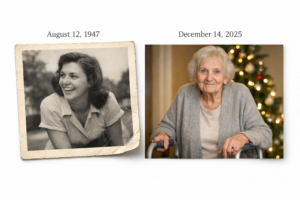
The first photograph was taken in 1947. She was a young girl then. Already curious. Already in motion. Already unmistakably herself. It is the kind of picture families keep without quite knowing why, sensing only that something important lives inside it. The second photograph was taken decades later. She is 89 now, standing in front of a Christmas tree, holding onto her walker. She offers a smile not because it is easy, but because she knows it matters.
Between those two moments is not a gap. It is a lifetime.
She loved being active. Tennis gave her focus and joy. Skiing gave her speed, balance, and a feeling of freedom. Movement mattered to her. It kept her connected to her body, her confidence, and the world around her.
Back in the 1950s, women were rarely encouraged to pursue higher education and were pushed toward more stereotypical paths. She stood out by attending an Ivy League university before she was eighteen.
One of the greatest love stories of her life began when she met a man several years older than her. He became her strength and her fiercest advocate. He made her laugh. He encouraged her when she doubted herself. Very quickly, he became her soulmate, her husband, and the devoted father of her three boys.
After his heartbreaking passing before his 40th birthday, her greatest challenge was summarizing their brief time together in three words. She had to choose carefully what would be carved in stone. She was practical. She was frugal. More words would have cost more. So the cemetery marker captured their life together in the simplest, truest way: LOVE. STRENGTH. TRUTH.
She loved theater, especially real drama. Off-Broadway plays where the rooms were small, and the ideas lingered long after the drive home. If a performance did not say something true, she had no patience for it. Time, to her, was never to be wasted.
She was a serious reader. Saul Bellow. Essays. Long-form writing that trusted the reader’s intelligence. She subscribed to The New Yorker starting in the 1950s and never stopped. These cartoon illustrations became idea magnets, taped to refrigerators and shared with everyone long before texting and email existed. They arrived by mail, with a postage stamp and a handwritten message. On long family trips, she read the letters to the editor out loud in the car, delighted by how people thought, how they argued, how ideas collided and sharpened.
Her favorite New York Times columns were Modern Love and Metropolitan Diary. But the news mattered most. She loved politics, stories about people, about cities, about ordinary moments that carried meaning.
If you entered a conversation with an opinion, you needed to be ready. She had the receipts. Facts. Memory. Context. She challenged people not to win, but to pay attention. Thinking clearly was a form of respect.
She traveled often, but not just for shopping or fancy dinners. Yes, famous landmarks made the cut, but it was the museums that were always the destination. The streets beyond the postcard view held her interest. She liked standing in front of a painting longer than most people would, letting history speak in its own time. Travel, for her, was about understanding how people lived and how the past stayed present.
The whole family joined in the journey. But as the years and decades flew by, there were heartbreaks, separations, and immeasurable losses. Then something magical happened in the latter years. Everyone reconnected. Friends from 60+ years ago. The entire family. Not just to confirm that it mattered, that it happened, but to remind her that she mattered, that she was loved (beyond words), and that they were grateful for all she did. She lived the dream.

She was a gifted artist across many mediums. Jewelry. Watercolors. Cartoon illustrations and fused glass were among her favorites. Her glass sculptures caught light and held it, shifting as the day moved on. She did not explain her work. She did not need to. It spoke.
Her house told her story better than words ever could. Books everywhere. Newspaper clippings saved for reasons only she fully knew. Playbills tucked into shelves and drawers. Notes slipped between pages. The refrigerator was covered in carefully handwritten quotes, reminders she refused to forget. And when the phone rang, it was a rotary or push-button phone with a long cord, always tangled and knotted from hours spent talking to friends. The Long Island home wasn’t a museum of perfect organization. When you walked in, you knew it was truly lived in. There was more chaos than minimalism, and that’s how you knew it was a real home. There were things everywhere to see, each one showing how much love filled the house.
She always carried a camera. Never to photograph food. Never to prove she was somewhere. She photographed people. Friends mid-conversation. Shared laughter. Small adventures. She wasn’t archiving her life. She was capturing moments she sensed would matter later.
She talked constantly, even while driving. Sitting felt like wasted time. Instead, she talked about books, politics, art, and memories she recalled with perfect clarity from decades earlier. The conversations were always worth listening to.
There were hard chapters. Serious roadblocks. Moments when independence shifted and time reminded everyone who was in charge.
And yet, even in her twilight years, her memory remained sharp. You didn’t need to ask if something really happened. You knew it did. She remembered.
She never ended a conversation without saying, “I love you.” Now, as memory begins to soften at the edges, the proof is still there. In the photographs. In the 35mm slides. In the home movies. In the books, the clippings, the handwritten notes. Those are her receipts. One day, hopefully many, many years from now, these images will tell her story. And the journey between them deserves to be safeguarded forever.
When memory softens, photographs remember.
[Written by Mitch Goldstone, a professional photo archivist who has preserved family photographs for over 35 years].