
America’s 30-Year Pandemic Debt Reckoning
Op-Ed By Mitch Goldstone, CEO at ScanMyPhotos
Key Takeaways
- The SBA EIDL debt crisis poses a significant challenge for small businesses, impacting their ability to hire, invest, or survive.
- The author urges Congress to investigate the SBA EIDL debt crisis and apply pandemic-era lessons to improve future relief efforts.
- Unlike other countries, America’s EIDL loans have long repayment terms and accumulate interest, potentially burdening businesses until 2050.
- International comparisons show different approaches, such as interest-free loans or partial forgiveness, which may yield better outcomes for small businesses.
- By analyzing outcomes from various countries, lawmakers can assess whether America’s approach effectively supported small businesses or left them in financial jeopardy.
Estimated reading time: 14 minutes
The SBA EIDL debt crisis caught my attention as a business owner, not an economist or Washington policy expert. I have spent 36 years, most of my life, running a small business. More than 20 years ago, I began asking questions about another system affecting millions of merchants: the interchange fees charged through the Visa and Mastercard payment-card networks. Most business owners treated those fees as another unavoidable cost of doing business. I couldn’t leave it there.
That question eventually led ScanMyPhotos and me to become the lead plaintiff in the massive antitrust litigation against Visa, Mastercard, and major banks. After nearly two decades, that case resulted in a $5.54 billion settlement benefiting millions of eligible merchants across America. The experience taught me something I have never forgotten: a problem can affect millions of businesses and still hide in plain sight because every owner assumes it’s theirs alone. Sometimes it takes one merchant, one reporter, one member of Congress, or simply one stubborn person to say, stop. Something doesn’t make sense here. Let’s look at what happened.
That is why I am speaking up about EIDL. I am not comparing the SBA to Visa or Mastercard. These are entirely different circumstances and legal issues. What feels familiar is seeing a system affecting an enormous number of businesses without enough people stopping to examine whether the system itself contributed to the damage. This time, the consequences can be devastating. Some mom-and-pop businesses are carrying federal pandemic debt that can influence whether they hire, invest, sell their business, retire, or simply survive. Many lost everything. 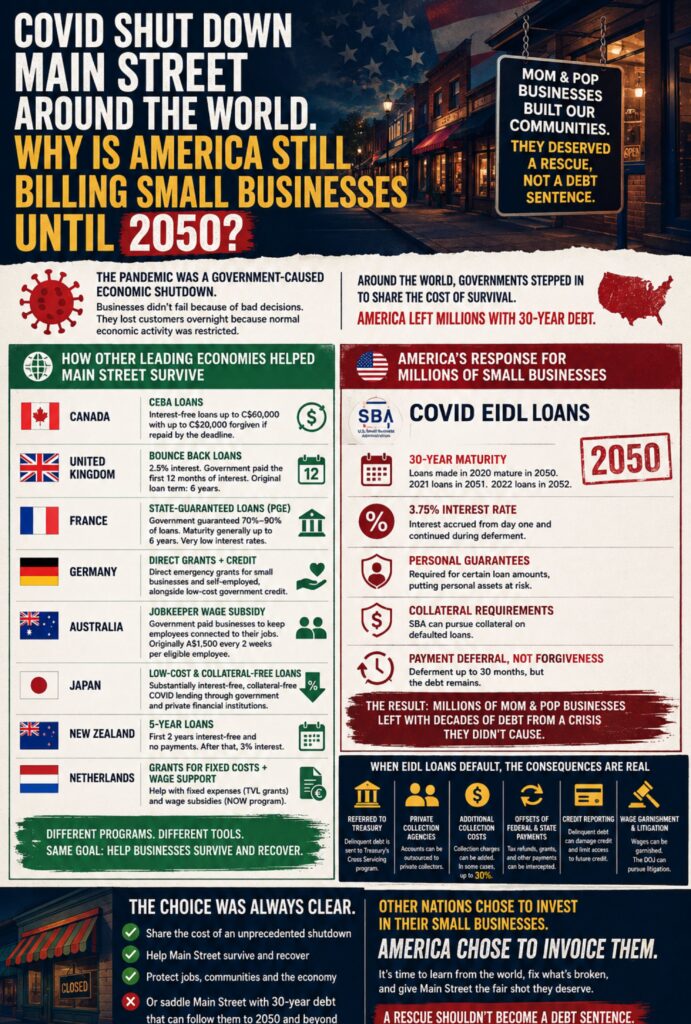
The Warning Was Already There
In January 2026, I wrote in The Hill that America’s pandemic rescue had become a “30-year debt trap.” I argued that EIDL’s long repayment terms, accumulating interest, and federal collection consequences were colliding with the reality of how small businesses actually survive. My concern then was straightforward: a program created to rescue Main Street during an extraordinary national emergency should not become a financial burden that follows viable businesses for decades. Read “How a pandemic rescue became a 30-year debt trap” in The Hill.
Then the Collection Story Got Bigger
Less than a month later, The Business Journals senior reporter Andy Medici documented another troubling piece of the story. His February 10, 2026 report found that small-business owners struggling with pandemic-era debt were being handed to federal debt collectors at record rates. That independent reporting matters because EIDL is no longer just a debate about what Washington did during COVID. For businesses being pushed into the federal collection system, the consequences are happening now. Read “Federal debt collectors are going after record numbers of people. Here’s why.”
So I am asking the question I learned years ago not to be afraid of asking: Did America choose the right way to rescue small businesses during COVID? Congress needs to find out.
When Main Street Had to Turn Off The Lights
COVID was never only an American crisis. Restaurants closed in London. Stores went dark in Toronto. Businesses lost customers in Paris, Berlin, Tokyo, Sydney, and Zurich. Owners everywhere faced essentially the same impossible math. Revenue disappeared, but rent didn’t. Payroll didn’t. Insurance didn’t. Utilities didn’t. Governments across the industrialized world suddenly had to decide who would absorb the cost. America responded on an extraordinary scale. PPP loans could be forgiven for qualifying borrowers. Grants and other programs provided additional help. But COVID Economic Injury Disaster Loans were different. The SBA approved almost four million COVID EIDL loans totaling nearly $378 billion. Apply, and typically within 48 hours, the funds were wired into their accounts with loan programs few (any?) financial institutions would ever dream of offering. Because it was all about arithmetic, and the math never worked. For businesses, the interest rate was 3.75%. The term could stretch to 30 years. Loans above $200,000 required personal guarantees. Borrowers eventually received up to 30 months of payment deferment, but interest kept accumulating. That means a business that borrowed during the shutdown in 2020 can still be making pandemic payments around 2050. That date alone should stop Congress in its tracks.
The World Ran the Experiment for Us
I started looking outside the United States because I wanted to answer one simple question. Did other major economies solve the same emergency by putting small businesses into debt for three decades? They generally did not structure their principal emergency programs that way.
- Canada created the Canada Emergency Business Account, providing about C$49 billion to nearly 900,000 businesses and nonprofits. The loans were interest-free, and qualifying borrowers could receive partial forgiveness of up to one-third. By December 2025, C$41.1 billion had been repaid or forgiven, while C$7.4 billion remained outstanding.
- Britain took another approach through its Bounce Back Loan program. The government guaranteed the financing and covered the first 12 months of interest and fees. The rate afterward was 2.5%. The original term was six years, with options that could extend repayment to ten.
- France backed roughly €145 billion in emergency business loans. Its principal state-guaranteed program generally gave businesses a year before principal repayment and then allowed repayment to be spread over up to five additional years. Germany created rapid KfW emergency lending for small and mid-sized businesses, with the federal government assuming 100% of the credit risk on its rapid-loan program. Those loans carried a ten-year repayment term.
- Australia attacked one of the largest business expenses directly. Through JobKeeper, eligible employers initially received A$1,500 every two weeks for each eligible worker. Instead of requiring businesses to borrow every dollar needed to keep employees, the government absorbed part of the payroll cost.
- Japan also relied heavily on direct assistance. Its Sustainability Benefit program distributed roughly ¥5.5 trillion to about 4.24 million businesses and sole proprietors. Japan also provided rent support and government-backed financing. New Zealand used loans, but its Small Business Cashflow Scheme had a maximum five-year term. The first two years were interest-free, with no required repayments during that period, followed by a 3% annual rate.
- The Netherlands used wage subsidies and grants tied to lost revenue and fixed costs. Denmark subsidized wages and compensated qualifying businesses for fixed expenses while also providing assistance to self-employed people whose revenue collapsed.
- Switzerland may provide the most striking comparison. It issued government-backed COVID business loans to bridge pandemic liquidity shortages. Loans up to CHF500,000 initially carried 0% interest. In 2026, Switzerland again reduced the rate on those remaining smaller loans to 0%. Of CHF16.9 billion originally extended, only CHF1.7 billion remained outstanding in March. The remaining loans generally must be repaid by 2028, or by 2030 in hardship cases.
Put those dates side by side. Switzerland is generally finished by 2028, with hardship cases stretching to 2030. Some American EIDL borrowers can still be paying around 2050. That is not a small policy difference. It is an entirely different way of deciding who carries the cost of an emergency.
Somebody Had to Pay
No free solution to COVID existed. Governments paid. Taxpayers paid. Workers paid. Businesses paid. Banks took risks. Fraud occurred. Companies failed despite receiving help. Some programs were badly administered. The economic losses were real and had to land somewhere. That is exactly why this comparison matters. Canada forgave part of qualifying emergency loans. Britain paid the first year of interest. Australia paid part of payroll. The Netherlands helped cover fixed costs. Denmark subsidized wages. Japan distributed direct business assistance. Switzerland initially charged no interest on smaller emergency loans. Germany assumed the credit risk behind its rapid-loan program. America did many of those things too. But through EIDL, we also made an enormous decision that has received nowhere near enough attention. We put hundreds of billions of dollars of emergency working-capital debt onto small-business balance sheets and let repayment stretch across three decades. Maybe that was smart policy. Maybe it wasn’t. Six years later, we should know.
Nobody Was Buying a New Pizza Oven
Calling EIDL simply a business loan misses something important. These were not ordinary expansion loans. A restaurant was not borrowing because it wanted another location. A retailer was not financing a larger store. A manufacturer was not buying equipment expected to generate revenue for decades. COVID EIDL was emergency working capital. The program was intended to pay ordinary operating expenses businesses could have met had the disaster not occurred. Those last words matter because businesses needed this money precisely because normal economic activity had vanished. Customers stayed home. Stores closed. Restaurants emptied. Travel stopped. Events disappeared. Entire industries froze. America needed those businesses to survive until commerce returned. EIDL provided immediate liquidity, and that mattered enormously. But liquidity and relief are not the same thing. Liquidity gets a business through today. Relief determines whether today’s rescue becomes tomorrow’s problem.
The Meter Never Stopped
EIDL borrowers eventually received lengthy payment deferments, but interest kept accruing. Think about that from the perspective of a business owner waiting for customers to return. The government effectively said, you do not have to pay us yet, while the interest meter kept running. That was not a small detail. It meant some businesses emerged from the worst economic disruption of their lives carrying larger obligations before normal repayment had even begun. For a program created as disaster assistance, Congress should ask whether that made sense.
More Than One Million Warning Lights
We now know something about what happened afterward. As of June 2024, the Government Accountability Office reported that SBA was still servicing more than 2.25 million COVID EIDL loans. About 277,000 were more than 30 days delinquent, while another 1.11 million loans were in charge-off status. One point one million is not a number Congress should casually pass over. At some point, a figure that large demands a different question. Maybe an extraordinary number of small-business owners all became bad borrowers at the same time. Or maybe the design of a 30-year disaster loan created during a once-in-a-century economic shutdown deserves serious examination. Congress should not assume the answer. It should investigate it.
When the Lifeline Reaches Treasury
Federal debt also carries consequences that ordinary commercial debt does not. Seriously delinquent federal debt can enter the government’s collection machinery. Depending on the circumstances, that can involve federal payment offsets, credit reporting, private collection agencies, administrative wage garnishment, and litigation. Think about the sequence from the owner’s perspective. In 2020, the message was that America needed the business to survive. Then payments could be deferred. Then repayment started. Then came delinquency. Then collections. All from the same emergency. My earlier opinion piece in The Hill examined how an emergency rescue became a 30-year debt problem. But I now believe Washington has been asking the wrong question. Another hardship plan, a smaller temporary payment or Treasury collection all address what happens after borrowers struggle. First, we need to know whether the original design itself worked.
Small Businesses Don’t Have 30-Year Clocks
There is another piece of arithmetic Washington should consider. Bureau of Labor Statistics data show that only 34.7% of private-sector business establishments started in 2013 were still operating ten years later. COVID EIDL can run three times that long. That does not prove every 30-year business loan is wrong. It does show how unusual this structure is. A mortgage can finance an asset designed to last for decades. A 30-year disaster loan can follow a small business through recessions, ownership changes, lost leases, technological disruption, retirement, and whatever crisis comes next. I doubt anyone sitting in Washington during the panic of March 2020 spent much time thinking about what these businesses would look like in 2050. They were trying to prevent an economic collapse. I understand that. But it is no longer March 2020. We now have the luxury they did not have then. We can look at what actually happened.
The Most Useful COVID Study Hasn’t Been Done
Here is what I believe has been largely missed in the debate over the SBA EIDL debt crisis. The world gave us a remarkable economic experiment. Advanced economies experienced essentially the same global shock at essentially the same time, and their governments tried different solutions. Now we can compare the results. Congress should commission an independent study of America’s small-business pandemic programs against comparable industrialized economies. For every country, calculate the total assistance. Separate grants from loans. Calculate interest charged, principal forgiven, taxpayer losses, government recoveries, defaults, business failures, and remaining pandemic debt. Then follow the businesses. Did they hire again? Did they invest? Could they obtain ordinary financing? Could owners sell their companies? Could they retire? Did pandemic debt affect those decisions? Then publish one number that does not require an economics degree to understand: How many small businesses in each country will still be paying for COVID in 2050?
Maybe America Was Right
I genuinely do not know what that study will find. Maybe America got this right. Perhaps a 30-year loan at 3.75% ultimately protected taxpayers better, preserved more businesses, and produced better economic outcomes than the alternatives used elsewhere. If the evidence shows that, say so. But what if countries that subsidized payroll produced healthier businesses? What if paying fixed costs worked better than lending businesses money to pay them? What if partial forgiveness helped viable companies recover faster? What if shorter loans prevented emergency debt from interfering with investment years later? What if charging little or no interest during the emergency produced more tax revenue in the long run because more businesses survived and grew? Those are not Republican questions or Democratic questions. They are math questions. We should get the answers.
Congress Has More Than Two Choices
This debate does not have to end with two extreme choices: collect every dollar or forgive every loan. There is enormous room between them. Congress could stop future interest for qualified businesses that remain open and are making a good-faith effort to repay. It could credit some interest already paid toward principal. It could create earned principal reductions after years of payments. It could establish realistic settlements for genuinely distressed businesses, reconsider collection penalties, and shorten the remaining repayment horizon or waive the fees. It can also distinguish between businesses making a legitimate effort to repay and those engaging in actual wrongdoing. There are many possible solutions. Other countries already tried some of them. Study what worked.
I Have Seen What One Question Can Do
More than 20 years ago, I was a small-business owner staring at payment-card fees and asking why. I did not have the resources of Visa. I did not have the resources of Mastercard. I certainly did not have the resources of the nation’s largest banks. I had a question. That question became litigation. The litigation lasted nearly two decades. The resulting $5.54 billion settlement is now benefiting eligible merchants across America. It taught me that systemic problems do not announce themselves with flashing lights. Sometimes millions of people can experience the same problem individually without realizing they are part of the same story. Then one person asks why. One merchant can do it. One reporter can do it. One member of Congress can do it. Someone simply has to go first. That is what I am doing with EIDL. Look at the numbers, the defaults, the interest. Read the many Reddit community posts on this topic; most are heartbreaking. Look at collections. Most importantly, look at what happened everywhere else.
The Next Crisis Won’t Wait 30 Years
This isn’t just about fixing an old pandemic program. There will be another emergency. I do not know whether it will be another virus, a cyberattack, a financial shock, a natural disaster, a war, or something nobody has imagined. America may again need millions of small businesses to alter or stop normal operations for the public good. When that happens, Washington will again have to decide how to keep Main Street alive. Before writing the next rescue plan, we should understand what happened with the last one. Canada can teach us something. Britain can. France can. Germany can. Australia can. Japan can. New Zealand can. The Netherlands can. Denmark can. Switzerland certainly can. America can too. But first somebody has to compare the results.
2050 Is Too Long to Wait
The pandemic ended. The shutdowns ended. The capacity restrictions ended. The emergency declarations ended. Most pandemic relief programs ended. The EIDL debt stayed. Some of it can remain around 2050. A rescue should do more than keep a business alive during the worst economic emergency in generations. It should give that business a realistic chance to recover afterward. America succeeded in getting enormous amounts of liquidity onto Main Street when businesses desperately needed it. That accomplishment should not be erased from this history. Now comes the harder part. We need the courage to examine what happened next. I learned years ago that one small-business owner asking “why?” can eventually force an enormous system to answer. So I am asking again. If comparable countries protected their small businesses from the same pandemic without leaving them carrying emergency debt for nearly 30 years, why did America? Congress should investigate the SBA EIDL debt crisis, compare our results with the rest of the industrialized world, and fix what the evidence says we got wrong. Six years is long enough to wait. 2050 is not an acceptable deadline for an answer.
[Revised on September 2, 2026].