
Why Did We Document Our Whole Lives, Then Stop Looking?
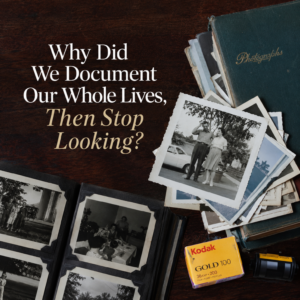
Somewhere in your home is the most complete autobiography you will ever create. It was never written, edited, or published. It is sitting in albums, envelopes, drawers, cabinets, closets, or boxes. It is the photographic record of your life.
For over 36 years, ScanMyPhotos has been helping families and businesses keep their photo memories safe. Throughout this time, one insight has really stayed with us: 96% of printed photos haven’t been looked at since they were first developed. It’s incredible to think about all the birthdays, vacations, weddings, graduations, holidays, friendships, pets, and everyday moments captured so lovingly — yet so many of those images are rarely seen again. While the photos have stood the test of time, the joy of viewing them often hasn’t.
That raises a surprisingly important question: Why did we spend a lifetime recording our stories, only to make them so difficult to read?
Every Click Cost Something
Before smartphones, taking a photograph required planning. You had to remember the camera, buy the film, load it correctly, check the batteries, and keep track of how many exposures remained. Most rolls gave you only 24 or 36 pictures, and every press of the shutter used one of them.
People didn’t just snap 20 similar photos and pick the best afterward. Instead, someone brought the family together, encouraged everyone to get closer, asked them to smile, and made sure no one’s head was cut off. The photographer quietly looked through the viewfinder and wondered: Is this moment worth using one of my precious shots? Even blurry images, closed eyes, or a thumb over the lens still had a chance. No one really knew how the photo turned out until the film was developed days or even weeks later.
That limitation gave each picture a sense of purpose. Most film photographs were not casual. They were small investments in the future.
People bought film because they believed a moment might matter later. They paid for processing because they wanted to see it again. Every photograph was a promise to a future version of themselves: Do not forget this.
The Kitchen Table Had Better Comments
Finishing the roll was only the beginning. You rewound the film, brought it to a photo lab, filled out an envelope, selected the print size, decided whether to order duplicates, paid for the processing, and waited.
Picking up the finished photographs often felt like an event. People sometimes opened the envelope before they reached the car. They flipped through the stack quickly, then looked again more slowly at home. The prints landed on a kitchen table or in someone’s lap, where they were passed from person to person. Someone pointed at a familiar face. Someone explained what happened just before the picture was taken. Someone laughed at the clothes, the wallpaper, the old car, or the hairstyle everyone once thought looked terrific.
The photograph did not simply show something. It started something. It created conversation, invited questions, and encouraged people to tell stories that might otherwise have disappeared. Each person looking at the picture added a different piece of the memory.
That experience is difficult to reproduce while one person scrolls alone through thousands of images on a phone. Printed photographs were naturally social. They moved from hand to hand, gathering stories as they traveled.
We Accidentally Made a Family Memoir
Few people write an autobiography, but almost everyone photographs one.
A photo collection can span 50, 60, or even 70 years, capturing thousands of special moments that no one could remember perfectly on their own. Think about the first house you lived in, the neighborhood you grew up in, your childhood bedroom, or even the family pet. Remember that birthday cake someone baked with love or the voices of relatives that still feel close even now. Many of the most cherished photos weren’t seen as special when they were taken—they were just everyday moments. But that’s exactly what makes them so precious and meaningful years down the line.
A picture of a child standing in a driveway might also capture the family station wagon, the old house, the garden, the neighbor next door, and a parent watching from the porch. The photographer may have focused solely on the child. Over time, everything in the frame can become meaningful. While smartphone photography isn’t necessarily worse, it often serves a different purpose. Today, a phone camera acts like a notebook, scanner, filing cabinet, reminder system, and proof recorder. We take photos of parking spaces, receipts, restaurant menus, serial numbers, medicine bottles, packages, appliance labels, and store shelves, reflecting how versatile our mobile devices have become.
Many of those images have a temporary job. They are useful for a moment, then disappear into a camera roll.
Film photographs usually had a different assignment. They were created for tomorrow. They said, in the simplest possible way, “This happened. These people were here. I may want to see this again.”
The Boxes Got Too Good at Their Job
Most people probably never intentionally decided to stop looking at their photographs. Life just got busy. Albums found a home on shelves, envelopes settled into drawers, and boxes shifted into closets, attics, garages, basements, and storage units. Children grew up and moved away, and over the years, pictures from different moments blended together. Finding that special memory started feeling like a bit of a treasure hunt.
Families did not stop caring about their photographs. They lost convenient access to them.
The collection stayed safe, but the joy gradually faded away. This reflects a common truth about family photography. Over the years, people have built a remarkable visual history, but interestingly, the better they get at preserving these memories, the less often they actually enjoy them. It’s not just about saving photos – it’s also about how we view them. That’s important because photos often give back much more than what’s visible inside their borders. A wallpaper pattern might remind you of an entire room, a shirt your father once wore could revive the sound of his voice, and a childhood friend might unlock a story you haven’t remembered in 40 years.
The memory was not necessarily gone. It simply needed the right key.
Old photographs offer more than nostalgia. They offer perspective. They show how much changed, what remained familiar, and who people were before life carried them in unexpected directions. They let us see our parents when they were young and ourselves before we knew how the story would unfold.
Digitizing old photographs does not create their importance. It makes that importance easier to experience. Digital copies allow pictures to return to family life, where they can be viewed, organized, enlarged, shared, protected, and passed to the next generation without someone first having to locate the correct box in the back of a closet.
You already did the hard part. You lived the life. You noticed the moments. You carried the camera. You bought the film. You waited for the prints. You saved the photographs for all these years. They were never meant only to prove that your life happened. They were meant to help you return to it.
Maybe the real question isn’t why we documented our lives, but rather why we put so much effort into creating these records, only to make them hard to enjoy. Your family didn’t spend decades building a photo archive just to keep it hidden away. They did it so that someone, someday, could look back and relive those memories.
That someone may be you.

Frequently Asked Questions
Why do people stop looking at old photographs? Most people do not intentionally stop. As collections grow and become harder to organize, albums and boxes move into storage. Busy schedules and limited access gradually reduce how often families see them.
Why do old family photographs trigger powerful memories? Photographs provide visual cues that can reconnect people with places, relationships, conversations, and emotions that may be difficult to recall without a prompt.
Why should printed photographs be digitized? Digitizing makes photographs easier to view, search, organize, protect, share, and pass to future generations. It also reduces unnecessary handling of fragile originals.
Are printed photographs still important in the digital age? Yes. Printed photographs may be the only surviving record of a person, home, neighborhood, celebration, or ordinary family moment that can never be recreated.
What is the biggest mistake families make with old photographs? The greatest mistake is not always losing them. It is preserving them so carefully that nobody gets to enjoy them.
[Revised July 24, 2026].