AI Can Fake a Memory. Your Photo Box Can’t.
 Scroll through social media today, and you will eventually wonder, Is that photograph real? It is a question we rarely ask until artificial intelligence arrives. Today, AI can create breathtaking images of people who never lived, childhoods that never happened, and family vacations that existed only inside a computer. The technology is improving so quickly that even experts sometimes disagree about what is authentic.
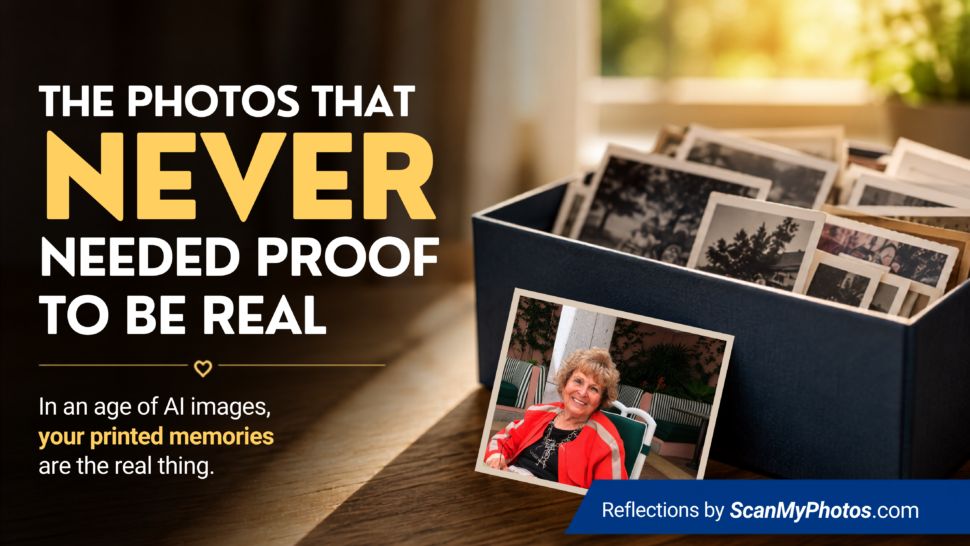
Ironically, the most trustworthy collection of photographs you own may not be stored in the cloud. It may be sitting in a faded cardboard box in your closet. Nearly every original printed photograph inside that box began the same way. Light reflected from real people, in a real place, on a real day, then passed through a camera lens onto film. Long before AI could invent convincing images, cameras quietly recorded authentic moments that became part of your family’s history.
That does not mean every printed photograph tells the whole truth. Photos have always been cropped, staged, retouched, or mislabeled. Still, original analog prints have something AI-generated images can never naturally possess: an authentic beginning. In an era when digital images are becoming harder to trust, your printed family photographs have quietly become something remarkable. They are among your family’s most believable records of the past.
The Clues Were There All Along
Most people look at old photographs and notice the faces first. Look again. Notice the scratched kitchen table where birthday cakes were served year after year. The family station wagon was parked in the driveway. The wallpaper everyone forgot. The handwritten note on the back. The child who blinked just as the shutter clicked. The dog wandered into the picture because nobody stopped to pose him.
Those tiny details were never meant to impress anyone. They simply happened. Today, they tell stories that no one imagined would matter decades later. AI is remarkably good at creating images that look believable. Real photographs preserve details that were never intentionally added because they were simply part of everyday life. That is what makes them so powerful.
Every original print carries more than an image. It carries context. The paper, the aging, the handwriting, the album it lived in, and the fingerprints left behind by family members who passed it around the living room all become part of its history. Those ordinary details quietly become evidence of an extraordinary thing: a real moment.
The Best AI Detector Knows Your Family
Technology companies continue developing tools to identify AI-generated images. Those tools may improve, but they will continue chasing technology that changes almost daily. Families already possess something that software does not: memory.
Your mother remembers the vacation cabin. Your uncle recognizes the old Chevrolet. Your sister knows exactly why everyone was laughing. Your grandfather remembers who stood just outside the frame. Archivists call this provenance, the documented history of an object. Families simply call it remembering.
That shared knowledge transforms a photograph into something far more valuable than pixels. It becomes a story that can travel from one generation to the next. Unfortunately, that knowledge has an expiration date. Every year, more names are forgotten. More places become mysteries. More photographs survive while their stories quietly disappear. The urgency is not only about preserving paper. It is about preserving meaning.
Open the Box Before It Disappears
A printed photograph can fade. It can be lost during a move. It can stick to another print after years in storage. Yet the greatest risk is not physical damage. It is silent. One day, the only person who knows the names, places, or stories behind a photograph may no longer be here to answer your questions.
That is why now is the right time to act. Open one box this weekend and choose ten photographs. Write down every name, place, date, and memory you can recover. Ask an older relative about the faces you do not recognize. Scan both the front and the back of photographs that contain handwritten notes. Preserve the stories alongside the images.
A high-quality scan protects what you can see. The stories protect what the photograph means. As digital images become easier to generate and manipulate, original printed photographs become even more valuable because they preserve something technology cannot naturally manufacture: a documented connection to real people and real moments.
Artificial intelligence will continue creating astonishing pictures. Your family’s printed photographs already hold something far rarer. They do not offer perfection, flawless composition, or impossibly beautiful lighting. They preserve authentic moments that began with real light, reflected from real lives, and were recorded long before anyone imagined a computer could invent memories.
Perhaps that is why those old photo boxes deserve a second look. They are not simply collections of pictures. They are among the last places where your family’s history never had to prove it was real.
[Revised on July 19, 2026].