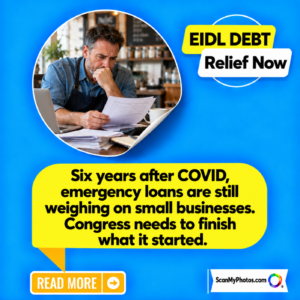
Washington Sold Main Street an SBA EIDL Lifeline. It Became a Noose.
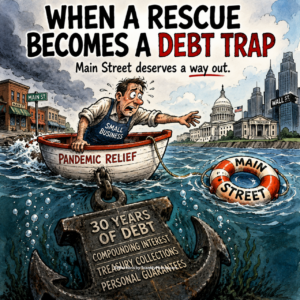
The rescue that became a trap: Pandemic loans were supposed to save Main Street. But when nearly 90% of small businesses close before the 30-year EIDL term ends, and some now owe more than they borrowed nearly half a decade ago, something is broken. That is not relief. That is a debt sentence.
An Op-Ed by Mitch Goldstone, CEO of ScanMyPhotos.com
During the pandemic, Main Street did not ask for a bailout. It asked for a chance to survive. Washington answered with the SBA Economic Injury Disaster Loan program, better known as EIDL, and sold it as emergency help for an emergency no business owner had ever planned for. It was described as a bridge, a lifeline, a way to keep employees paid, rent current, vendors calm, and lights on while the country shut itself down.
Millions of small business owners grabbed that lifeline because, in that moment, there was no real choice. When the ship is taking on water, nobody pauses to read 30 years of fine print while the crew is screaming and the floor is disappearing beneath them. They grab the rope. They pray it holds. They do what they have to do to stay alive. Immediate liquidity was needed. Press a few buttons, and the SBA was the best way to get the funds into the account within 2-3 days to prevent the economy from crashing further.
Now, years later, too many of those same business owners are discovering the ugly punchline. The rescue did not end when the pandemic ended. It followed them. It accrued interest. It outlived shutdowns, masks, supply shocks, inflation, labor shortages, rent hikes, insurance spikes, and the comforting fiction that small businesses can absorb endless damage because politicians like calling them resilient.
Resilient is what Washington calls you when it wants applause for your suffering.
The Hill: How a pandemic rescue became a 30-year debt trap
In 1990, I co-founded what is now ScanMyPhotos.com, a small California business that serves customers across America. We built it the old-fashioned way, one order, one customer, one payroll, one rent check, one crisis at a time. I am still CEO and Cofounder, and I am not stepping away from that work. But I am stepping forward on this issue because what happened to millions of small business owners was not normal lending. It was emergency lending during a once-in-a-century national disaster, wrapped in government reassurance, then handed back to borrowers as a 30-year private burden. That is not relief. That is a debt trap with a federal seal.
The math was broken from the start. Small businesses do not live on 30-year timelines. They live invoice to invoice, season to season, payroll to payroll. A restaurant does not know what food costs will be in 30 months, much less 30 years. A retailer cannot predict rent, foot traffic, tariffs, credit-card fees, insurance, labor costs, online competition, or the next economic body slam.
Yet Washington designed pandemic disaster loans as if Main Street were a utility company with guaranteed revenue. It is not. The Bureau of Labor Statistics has reported that only about one-third of private-sector businesses established in 2013 were still operating ten years later. That means most businesses do not survive even one-third of an EIDL repayment term. That is not a character flaw. That is the life cycle of small business. So the question Congress should be asking is painfully simple: Why did the federal government offer 30-year disaster loans to businesses that the real economy shows often do not last 30 years?
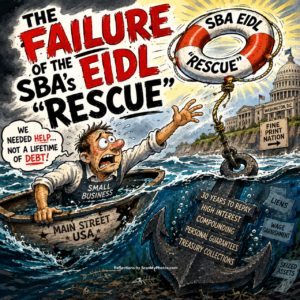
The harder questions follow. Why did interest accrue while borrowers were still recovering? Why were deferments treated like mercy when they allowed balances to grow? Why did hardship programs reduce payments temporarily while leaving the same debt waiting at the end of the hallway like a bill collector in a bad movie? And why is Congress not holding emergency hearings right now?
This is the part Washington prefers to blur. A deferment is not forgiveness. A hardship plan is not repair. A temporary payment reduction is not a solution. It is aspirin for a broken leg. It may make the patient feel slightly better for a few hours, but the bone is still broken. Many business owners accepted EIDL funds because they were told help was available during a declared emergency. They were not sitting around trying to game the system. They were trying to keep workers employed, vendors paid, landlords calm, families afloat, and communities functioning. They did what America asked. They stayed open. Then the bill arrived.
For some, the balance is now higher than the original loan. For others, personal guarantees put homes and savings at risk. For those sent into collection, Treasury involvement can mean added fees, offsets, credit damage, and a bureaucratic maze that feels designed by people who have never had to make payroll on a Friday. The cruelty is not only financial. It is psychological. Ask a small business owner what this feels like, and you will hear the same words again and again: trapped, invisible, ashamed, angry, exhausted. These are people who survived the pandemic only to be haunted by the rescue.
Washington will say borrowers signed documents. That is true. Washington will say taxpayers must be protected. Also true. Washington will say fraud must be pursued. Absolutely true. But none of that answers the central question: Was the SBA EIDL program designed realistically for the businesses it was supposed to save?
The answer is no.
If a private lender designed a 30-year product for borrowers whose survival rates collapse long before the final payment, allowed interest to pile up during crisis deferrals, and then pushed struggling borrowers toward harsh collection machinery, regulators would have questions. When government does it, everyone calls it policy.
That should not be good enough.
This is not a plea for irresponsibility. It is a demand for accountability. Congress should immediately hold public hearings on the SBA EIDL program, not someday, not after another report, not after the next Congress is elected, not after more businesses disappear, but now. Lawmakers should require the SBA and Treasury to publish clear, current, plain-English data on how many COVID EIDL loans are current, delinquent, charged off, referred for collection, subject to offsets, personally guaranteed, tied to closed businesses, or carried by still-operating businesses that are barely hanging on.
No more fog. No more “trust us.” No more pretending that a national emergency loan program can be judged only by whether the government sent the money out quickly. The real test is what happened next.
Congress should examine a practical repair plan that freezes interest for verified good-faith borrowers, caps or removes Treasury collection surcharges for small businesses that tried to repay, applies certain interest payments toward principal, protects credit reports for borrowers who entered hardship programs or made partial payments, reviews personal guarantees on emergency disaster loans issued under pandemic pressure, and creates a restructuring path that keeps viable businesses alive instead of pushing them into liquidation.
Washington has rescued banks, airlines, automakers, farms, and foreign allies when leaders decided collapse would cost more than action. If policymakers can entertain a reported $300 billion reconstruction plan tied to Iran’s economic future, they can surely confront the SBA EIDL debt crisis crushing American small businesses that followed the rules during a national emergency.
Lawmakers should also be honest enough to consider ending future payments for borrowers who acted in good faith, especially where continued collection will cost more in business closures, lost jobs, empty storefronts, legal churn, and administrative drag than it will ever recover. Washington understands this logic perfectly when banks wobble, airlines struggle, automakers buckle, farms need help, or foreign governments require emergency support. Suddenly, intervention becomes prudence.
Business Journals: Federal debt collectors are going after record numbers of people. Here’s why.
But when Main Street asks for the same seriousness, it gets a lecture about obligations. Spare us.
Small businesses know obligations. We live by them. We pay employees before ourselves. We answer customer emails at midnight. We cover rent when sales are down. We eat the mistake when a vendor fails, a shipment disappears, a system crashes, or a customer needs help. Small business owners do not need lectures on responsibility from a government that designed a rescue program with a repayment schedule longer than many businesses survive.
What we need is repair.
This fight is not Republican or Democratic. The pandemic did not check party registration before it destroyed revenue. Inflation did not ask whether a restaurant owner watched Fox News or MSNBC before doubling food costs. Treasury collection notices do not arrive in red envelopes or blue envelopes. This is Main Street against indifference. It is the small manufacturer in Ohio, the family retailer in California, the restaurant in Texas, the salon in Nevada, the independent contractor in Florida, the service business in Pennsylvania, and the neighborhood shop that sponsored Little League, donated gift cards to school fundraisers, hired local kids, paid taxes, survived the shutdown, and now wonders why the country it helped hold together has moved on.
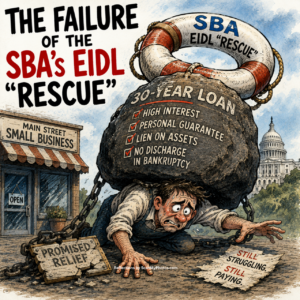 America loves small business as a slogan. It is time to prove it as policy.
For 36 years, my company has helped families preserve photo memories. We have also engaged on important issues affecting small businesses, including serving as lead plaintiff in the merchant credit card payment antitrust settlement that secured $5.54 billion for millions of U.S. companies. Now I am fighting to preserve something else: the American promise that if you build something honest, employ people, serve customers, and survive disaster, your own government will not turn its emergency rescue into the weight that finally pulls you under.
The SBA EIDL crisis must be addressed immediately, not buried in another report, not softened by another temporary payment plan, and not postponed until more businesses close and more families lose everything. Congress needs hearings. Borrowers need transparency. Taxpayers need honesty. Main Street needs relief that actually repairs the damage.
During the pandemic, small businesses showed up for America. Now America needs to show up for them.
SBA EIDL Debt Crisis FAQs
1. What is the SBA EIDL debt crisis?
The SBA EIDL debt crisis refers to pandemic-era Economic Injury Disaster Loans that helped small businesses survive COVID, but now leave many owners facing 30-year debt, interest buildup, personal guarantees, and possible federal collections.
2. Can SBA EIDL loans be forgiven?
Most SBA EIDL loans are not currently forgivable. That is why many borrowers are calling for Congress to hold hearings and consider relief, restructuring, interest freezes, or other hardship reforms.
3. What happens if you cannot pay an SBA EIDL loan?
If a borrower cannot pay, the loan may become delinquent, be charged off, or be referred for federal collection. Borrowers may face added fees, credit damage, offsets, or collection actions.
4. Do SBA EIDL loans go to Treasury collections?
Yes. Delinquent COVID EIDL debts may be referred to the U.S. Treasury’s collection system, where added fees and collection pressure can make repayment even harder.
5. Why do some SBA EIDL borrowers owe more than they borrowed?
Many borrowers received deferments or hardship payment plans, but interest could continue to accrue. That means some balances grew even while owners were trying to recover.
6. Will Congress provide SBA EIDL relief?
No broad SBA EIDL relief has been passed yet. Borrowers, advocates, and small business owners are pushing Congress to hold hearings and consider practical fixes before more businesses close.
Mitch Goldstone is CEO and Cofounder of ScanMyPhotos, a California-based small business founded in 1990. Since 2005, he has served as lead plaintiff in a long-running merchant interchange payment card class action lawsuit that resulted in a $5.54 billion settlement benefiting millions of U.S. merchants. He is now advocating for congressional hearings, transparency, and practical reform for small business owners affected by pandemic-era SBA EIDL debt.