Anatomy of the SBA EIDL Loan Program Failure
- The SBA’s EIDL loans, intended to help small businesses during the pandemic, ultimately led to many failures.
- Borrowers faced unsustainable repayment terms, leading to financial distress despite their good-faith efforts.
- My past experiences with credit card payment systems highlight the importance of structural integrity in financial programs.
- The Hill op-ed I wrote argues that flaws in the loan design result in slow-motion credit traps rather than genuine relief for struggling businesses.
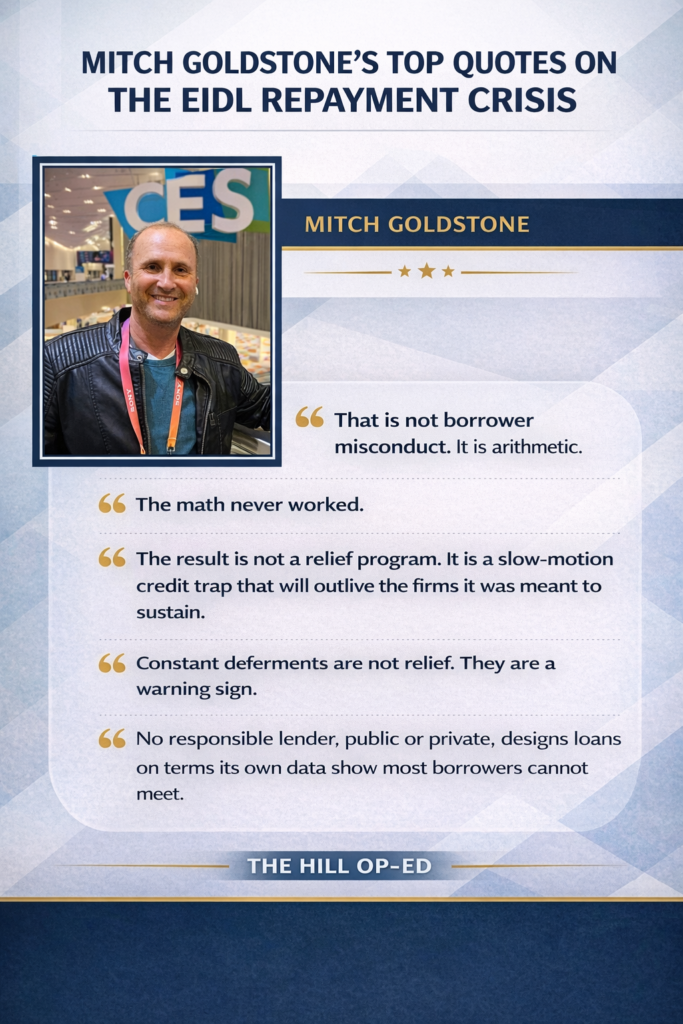
- Business owner Mitch Goldstone addresses the consequences of these loans, emphasizing that the issues stem from arithmetic, not borrower misconduct.
- The full op-ed was published in The Hill. You can read it here.
[Editor note: On January 18, 2026, this page was updated to include the most popular FAQs being received]
Estimated reading time: 8 minutes
How SBA’s EIDL Pandemic Loans Broke Businesses
By Mitch Goldstone, CEO, ScanMyPhotos
This heartbreaking scenario is unfolding across the country. The rescue plan was simple: a lifeline to survive the global COVID catastrophe. Even if a company’s sales double, the debt may outlast the company. Many businesses survived the pandemic. They may not survive the math of the SBA’s emergency EIDL support.
A Pattern I Had Seen Before
As a contributor, when I wrote the op-ed for The Hill, I sensed déjà vu. Twenty years ago, I noticed a similar glitch in the machinery of commerce. Back in 2005, as a business owner, I noticed something that did not make sense in the credit card payment system. Millions of merchants, including ScanMyPhotos, regularly received two letters each year announcing increases in merchant credit card interchange fees. One came from Visa. One came from Mastercard. They often arrived on the same day. The language was nearly identical. The price increases were identical! Interchange fees are the electronic transaction fees that merchants pay each time a customer uses a credit or debit card. The fees are set by card networks and banks and deducted from each sale. Visa and Mastercard were widely understood to be competitors. Yet their pricing moved in parallel.
That stopped me cold.
When I looked more closely, I learned that the same major banks owned both networks. At the time, Visa and Mastercard operated as bank-owned associations. Their boards were composed of representatives from those same banks. Structurally, the networks were not independent of one another, even though they appeared to be. Those facts became central to a nationwide antitrust challenge. ScanMyPhotos became the lead plaintiff in In re Payment Card Interchange Fee and Merchant Discount Antitrust Litigation (MDL No. 1720). In my case, as lead plaintiff, along with many others, we alleged that interchange fees were set through coordinated conduct (anticompetitive collusion and price fixing) rather than through genuine competition.
The litigation led Visa and Mastercard to go public, switch to independent boards of directors, implement governance changes, increase transparency, and ultimately reach a $5.54 billion settlement with U.S. merchants. It helped millions of small businesses recover money they were owed, and it remains one of the most meaningful outcomes of my professional life.
But the lasting lesson was not about the lawsuit itself. It was about structure.
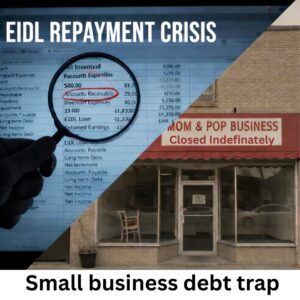
The Math Never Worked
That recognition came from experience. Over the past few years, I began paying closer attention to what happened after pandemic relief ended. As repayment began, small business owners started sharing their stories publicly. The details differed, but the outcomes were strikingly similar. Revenue never fully returned. Interest continued to accrue. Repayment obligations grew faster than cash flow could recover.
These businesses were not failing because of reckless decisions. Many failed because the financial structure they were placed in could not sustain itself over time. One account stayed with me. A business owner described sitting at the kitchen table, paperwork spread out, realizing that even if sales improved, the loan balance would still outlive the company. The business survived the shutdown. It could not survive the structure meant to save it. That feeling was familiar.
A Pattern I Had Seen Before
When I examined the stories about the SBA’s EIDL loans, I saw the same structural failure. Speed to provide liquidity was the priority during the emergency, and rightly so. But roughly 90 percent of small businesses do not last thirty years. Many do not even reach ten. Designing a repayment schedule that spans decades is not a rescue mission. It is a slow-motion credit trap. When a loan’s terms are designed so that the majority of borrowers cannot possibly meet them, the problem is no longer about “misconduct” or “bad management.” It is simple, brutal arithmetic.
We are currently witnessing another national disaster in slow motion. Constant deferments, as interest payments keep accruing, are not a form of relief; they are a flickering red warning light on a dashboard. No responsible lender creates a product whose own data proves it will fail.
When Design Fails, Not Intent
When I examined the pandemic loan repayment terms, timelines, and small-business survival data, the pattern reappeared. The programs were created quickly in response to a genuine emergency. Speed mattered. Survival mattered. How could the government provide immediate liquidity to save the economy and millions of businesses? The SBA’s EIDL loans were the “solution.” But once repayment begins, assumptions stop being theoretical. When repayment schedules stretch across decades, the problem is not borrower behavior. It is math. It is arithmetic.
Why I Spoke Up Now

I did not write the piece assigning blame to the SBA’s EIDL loans for breaking small businesses. I wrote it because, once repayment began, the consequences of the loan design became measurable and unavoidable. Constant deferments are not relief. They are a warning sign.
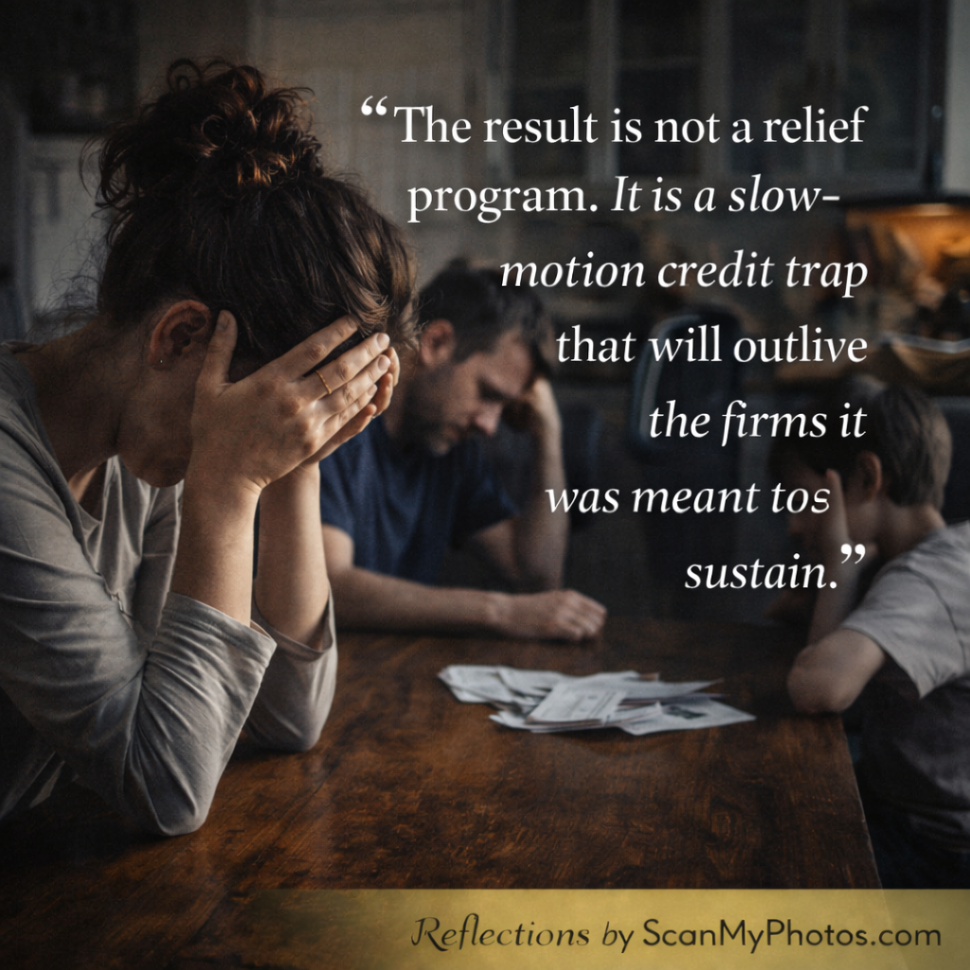
No responsible lender, public or private, designs loans with terms its own data show most borrowers cannot meet. When that happens at scale, the result is not a relief program. It is a slow-motion credit trap that will outlive the firms it was meant to sustain. Ignoring patterns does not make them disappear. It only delays their impact. That recognition led me to write the Hill op-ed, and that is why I am speaking now.
The full op-ed was published in The Hill. You can read it here.
SBA EIDL Frequently Asked Questions (SBA FAQs)
Survival doesn’t make a flawed design work. These loans can stretch up to 30 years. Most small businesses (90%) don’t operate on timelines like that. That mismatch exists whether one company survives or not.
Because context matters. These loans weren’t signed under normal circumstances. They were signed during a national emergency, when businesses were being shut down overnight, and revenue dropped to zero. Owners weren’t calmly weighing options. They were trying to survive. If you’re in a pool and you start drowning, and there’s one thing floating next to you, you grab it. You don’t stop to ask how long it will last. That’s what happened here. The government offered a lifeline. Businesses took it in good faith. The issue isn’t whether the paperwork was legal. The issue is whether the structure made sense once the emergency passed. As I wrote in The Hill, the math never worked in the long term. Repayment schedules that stretch for decades assume a level of stability most small businesses simply don’t have. That’s not misconduct. That’s reality. Emergency decisions are supposed to save you in the moment. They’re not supposed to pull you under years later.
No. ‘Bailout’ is the wrong word. Bailouts may excuse bad decisions. This fixes bad design. These loans were issued during a national emergency, after shutdown orders. A more accurate term is emergency program repair.
Because the EIDL loans did their job during the crisis, but the bill outlived the emergency. The money kept businesses open and is long gone, yet payments now stretch over 30 years, often with interest piling up daily, meaning many now owe more than they received six years ago. This may be their biggest expense. Ignoring a fix guarantees more failures and higher costs later. The EIDL program was designed to stabilize the economy, not weaken businesses years later. Ignoring that failure only multiplies the cost.
This wasn’t a business mistake. This was an emergency shutdown. You can’t tell small businesses to just deal with it. When the rules change overnight, the cleanup can’t be left to chance. That wasn’t the case for the tens of billions of dollars in direct assistance to U.S. farmers, billions to airlines, and over $80 billion to the auto industry. During the 2008 financial crisis, Congress authorized $700 billion through the Troubled Asset Relief Program to prevent systemic failure. In 2020, the CARES Act deployed more than $2 trillion in emergency spending to stabilize the economy. In each case, policymakers concluded that intervention was less costly than collapse.
This isn’t forgiveness. It’s a reset of a program that broke. Broken systems don’t get forgiven. They get fixed.
They didn’t sign because they studied the paperwork. They signed because their doors were about to close. They were grabbing driftwood to keep lights on, not negotiating a contract. These loans occurred during chaos. Businesses were closing overnight. Speed in providing immediate liquidity mattered more than the fine print. It was like clinging to the only piece of driftwood in a storm. There was no time to debate long-term consequences. Millions of businesses grabbed the only lifeline available to survive. The result is not a relief program. It is a slow-motion credit trap that will outlive most of the firms it was meant to sustain.
Defaults at this scale are historic. When the numbers are this big, it’s not a borrower problem. It’s proof that the program, hastily built to move money quickly during a shutdown, failed. The numbers are staggering and unlike any other lending program. The SBA reported that about 1.3 million EIDL loans are in default, in liquidation, or have been charged off. Proof that the math didn’t work.
Target the abuse. Fix the system. Protect the businesses that play by the rules. You isolate misuse. You don’t punish everyone else.
A 30-year loan assumes 30 years of steady cash flow. Most small businesses don’t work that way. When the clock doesn’t match reality, failure is baked in. Outside of government emergency programs, this is why banks don’t offer 30-year loans to small businesses.
Because when failure costs more than fixing it, you fix it as done previously. That’s not a bailout, it’s a cleanup. And waiting only makes the mess more expensive. Because governments step in when the cost of failure exceeds the cost of repair. That’s not radical. That’s standard crisis cleanup. Stability matters at every level. There is a clear precedent for federal relief when the cost of collapse exceeds the cost of intervention. The U.S. has approved tens of billions for farmers, billions for airlines, over $80 billion for automakers, $700 billion through TARP in 2008, and more than $2 trillion under the CARES Act in 2020. In every case, policymakers concluded that prevention was cheaper than failure. The U.S. has even provided roughly $20 billion in support for Argentina. Now, $700 billion is being discussed for Greenland, a place not for sale, while millions of small businesses hear silence on SBA EIDL relief.
Because I’m reading the stories every day, and they’re heartbreaking. Families who did everything right. Parents who held their businesses together through the shutdowns, only to lose everything later when the debt caught up. Kids watching their parents’ life’s work disappear. Communities are losing the small businesses that anchored Main Street. I engaged for the same reason as in the credit card case. I saw something that didn’t add up, and the damage it was causing to real people. When you see a system hurting people who acted in good faith, you don’t look away. You speak up. The math shows the problem. The stories show the damage. It always takes one person, one voice, to raise the spotlight and fix things.
I’ve spent decades watching how financial systems affect small businesses. I’ve seen what happens when design flaws are ignored too long. I’m raising this now because I’m hearing the impact every day. I read the stories, and they show how this is affecting real families and small businesses. How many people do you know who took on the banks and credit card associations and won $5.54 billion for millions of merchants? I’ve seen what happens when design flaws are ignored too long. This follows the same pattern. This isn’t about one company speaking up in support of those in distress, but about all those affected and sharing their stories.
Freeze interest for good-faith small businesses, apply past interest payments to the loan balance, protect credit scores, reduce penalties for those trying to repay, require Congress to review how the loans were designed, publish clear data, and end future payments to rescue millions of struggling small businesses.
Because speed mattered more than modeling in 2020. The economy was in free fall, and speed beat spreadsheets. The goal was to stop a free-fall. Long-term survivability wasn’t fully tested against real small-business data. That’s understandable in an emergency. What’s not understandable is ignoring the results once the data is in.
More closures. More families lose everything after surviving the shutdowns. More empty storefronts. Lost tax revenues. Less local hiring. Less community stability. And the longer this drags on, the harder it becomes to fix.
Because small businesses aren’t just owners. They’re jobs, first paychecks, and places communities rely on. When small businesses disappear, everyone feels it. Emergency pandemic loans helped businesses survive shutdowns, but their long-term design now clashes with the realities of small-business economics, with real human consequences.
Yes. He is committed to bringing this issue into the spotlight, just as he did with the banking class-action lawsuit he led. He can be reached through the contact page at ScanMyPhotos.com.
Mitch Goldstone is the CEO of a California-based photo scanning service founded in 1990. Since 2005, he has served as lead plaintiff in a 20-year merchant interchange payment card class action lawsuit, which resulted in a $5.54 billion settlement benefiting millions of U.S. merchants. The Hill® is a leading Washington publication read daily by lawmakers, regulators, policy staff, and national media. Its opinion pieces often shape political debate and influence how issues are discussed inside Congress and federal agencies.