
Key Takeaways
- TikTok has updated its Terms of Service and Privacy Policy, affecting how user content is handled in the U.S.
- The new TikTok privacy TOS allows for extensive data collection, including precise location and biometric identifiers.
- Families should understand the implications of uploading digitized photos, as TikTok can analyze and reuse those materials.
- ScanMyPhotos warns that sharing family memories with TikTok comes with privacy risks that deserve careful consideration.
- This isn’t a call to abandon TikTok, but users should pause and review the updated terms before sharing irreplaceable content.
Estimated reading time: 5 minutes
Rich Demuro, nationally recognized tech journalist and host of “Rich on Tech” reported on Facabook: Now that TikTok is officially operating in the U.S. as TikTok USDS Joint Venture LLC, it just updated its Terms of Service and Privacy Policy, and there are some things you should understand.
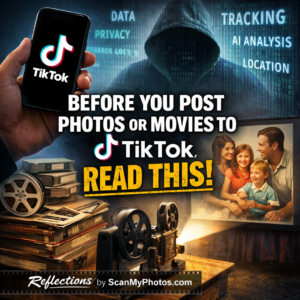
In the United States under a new corporate structure, has required users to accept updated Terms of Service and a revised Privacy Policy in order to continue using the app. Those documents describe how the platform can collect, analyze, infer, store, and reuse user content and behavioral data.
Much of this has been covered by technology reporters in recent days. But from the perspective of a company that digitizes photos and home movies every day, the implications are deeply personal.
Why This Is Coming From UsBefore You Post Family Memories to TikTok, Read This
A photo digitization company warns customers that TikTok’s new U.S. privacy terms change what happens to your digitized photos, slides, videos, and home movies once they’re uploaded.
For everyone, digitizing old photos and home movies is an act of trust.
These are not casual files. They are images of children growing up, parents who have passed away, homes that no longer exist, voices that cannot be recreated. When people take the step to digitize them, they are not thinking about algorithms or ad networks. They are thinking about preservation.
That is why we are sharing this advisory now.
TikTok, which now operates i
At ScanMyPhotos, families send us boxes filled with their lives. Printed photographs. Slides. Film reels. VHS tapes. Home movies that have not been watched in decades. People digitize these memories for two primary reason. To share them. To keep them safe. The company has been safeguarding photos for 36 years.
“We are strong advocates of social media. Sharing is often the reason customers digitize their photos in the first place. Social platforms reconnect families, bridge generations, and turn private memories into shared stories, said Mitch Goldstone CEO and chief photo archivist at ScanMyPhotos.
But advocacy also carries responsibility.
If a major platform updates its privacy rules in ways that could materially affect how deeply personal family media is handled, analyzed, or repurposed, staying silent would be a breach of trust with the people who rely on us.
What TikTok’s Updated Privacy Policy Allows
Based on TikTok’s published ToS policy language and independent reporting, the updated terms allow for the following.
🚨 Precise location collection: TikTok states it may collect precise GPS-level location data when users enable location services, not just approximate location.
🚨 AI interaction and content logging: The policy confirms that prompts, uploaded files, and generated responses from TikTok’s AI tools may be collected and used to train and improve its systems.
🚨 Expanded off-platform tracking: TikTok receives data from advertisers and partners about websites visited, products purchased, and apps installed, which can be used to target ads on TikTok and across the web.
🚨 Sensitive personal data inference: Reporting shows TikTok may collect or infer information related to health, mental health, sexual orientation, immigration or citizenship status, financial information, and precise location.
🚨 Biometric identifiers where permitted by law: TikTok’s policy allows the collection of biometric identifiers such as faceprints and voiceprints from user-generated content where legally allowed.
🚨 Broad behavioral data collection: Device identifiers, interaction timing, usage patterns, and other behavioral signals may be collected and analyzed.
🚨 Irrevocable content licenses: Content uploaded to TikTok is subject to a worldwide, royalty-free license. Deleting a video does not necessarily undo rights if the content has already been processed or analyzed.
🚨 Mandatory acceptance: Users must accept these terms to continue using the platform.
TikTok’s updated U.S. Privacy Policy can be read directly on the company’s site here
Why This Matters for Family Who Scanned Their Photos and Home Movies
Old photos and home movies contain information modern platforms value highly. Faces across generations. Voices. Homes. Neighborhoods. Children aging over time. When a platform reserves the right to analyze uploaded content, infer personal traits, and retain broad licenses, families deserve to understand what that means before they upload irreplaceable material.
As Mitch Goldstone, CEO of ScanMyPhotos.com, puts it:
“People don’t digitize family photos so algorithms can study them. They digitize them to preserve history, share love, and safely protect what matters. If a platform changes the rules around how those memories can be used, our customers deserve to know that before they click upload.”
One distinction is especially important: “A moment shared with family is not the same as a moment shared with an algorithm.”
A Pause, Not a Panic
This is not a call to delete TikTok. Millions of people enjoy the platform every day, and many will decide the tradeoff is acceptable. But for digitized family photos and home movies, of private homes, or loved ones, a thoughtful pause is reasonable. Privacy policies describe what companies are allowed to do, not what they promise never to do. For families who digitize their memories to preserve them, that difference matters.
The Bottom Line
Digitizing family history is an act of care. Sharing it should be an act of intention. As advocates for both social connection and consumer rights, ScanMyPhotos believe people deserve to understand the rules before handing over pieces of their lives.
Disclosure: This article is based on TikTok’s publicly available Terms of Service and Privacy Policy, along with independent reporting. This is not legal advice. Readers are encouraged to review TikTok’s policies directly and make their own decisions about what content they choose to upload.
(Updated January 23, 2026)
-
TikTok USDS Joint Venture privacy
-
TikTok Terms of Service update
-
TikTok privacy risks 2026
-
Digitized family photos privacy
-
Uploading home movies to TikTok
-
TikTok biometric data collection
-
TikTok AI data usage
-
Social media privacy family memories