
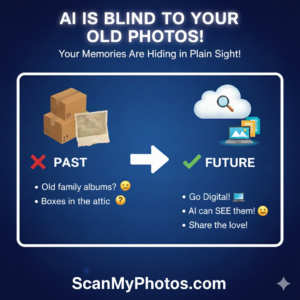
 AI Can’t See What Was Never Digitized
Artificial intelligence is often described as all-seeing. It isn’t.
AI systems can only work with what exists in digital form. Images that were never scanned or stored digitally are invisible to them. They are not misread. They are not misunderstood. They are simply absent.
That blind spot shapes how AI learns and how it draws conclusions.
A Simple Question With a Direct Answer
The issue usually surfaces through a basic question: how does AI know what it is looking at?
The answer is straightforward. AI does not learn from experience or memory. It learns from available data. When that data is incomplete, its understanding is incomplete as well. No amount of computing power changes that.
A Missing Visual Record
Most visual history predates the digital era. It exists on paper, in albums, in boxes, and in storage spaces meant to preserve it. Family photographs. News images. Research material. Cultural records. Everyday documentation that never seemed urgent enough to convert. From the perspective of modern AI systems, this material does not exist.
When Loss Makes the Gap Clear
Recent disasters have made this limitation harder to ignore. Fires, floods, and severe storms have destroyed homes and personal collections in hours. When people describe what they lost, they rarely begin with furniture or possessions. They talk about photographs. For many families, those images were the only record of certain people or moments.
When analog photos are destroyed, the loss happens twice. The images are gone from personal memory, and they are also absent from the digital record that increasingly shapes how the future understands the past.
Beyond Sentiment
Photo digitization was once treated as a sentimental task. Something to do when time allowed. That framing no longer fits. AI systems are now used to search visual records, establish context, identify patterns, and support decisions. But they cannot learn from material they cannot access.
As a result, powerful systems are being trained on a partial visual history of the world. Not because the rest did not exist, but because it was never digitized.
A Shift in Awareness
People are becoming more aware of how fragile analog records are. Fires spread faster than expected. Water reaches places thought to be safe. Time proves unreliable. There is also growing recognition that images left outside the digital world are left outside how future systems interpret the past.
Memory Still Matters
AI is designed to look forward. But intelligence without memory lacks context. If technology is meant to reflect the world accurately, it cannot rely only on what happened to survive the transition to digital form. AI is not broken. It is incomplete. The gap is not intelligence. It is memory. Photo memories. Yours!