
Key Takeaways
- Analog photographs are prone to accelerated decay due to moisture, light, and time, making digitization a crucial process.
- High-resolution digitization preserves your personal history by converting photos into a stable digital format.
- AI technology enhances digitized photos, repairing damage and organizing collections for easy access.
- Waiting too long to digitize can lead to irretrievable losses, as exemplified by a journalist’s last-minute, urgent effort after a tragedy.
- To protect your family’s memories, gather photos, choose a professional scanning service, and act now before it’s too late.
Estimated reading time: 5 minutes
The clock is not a friend to your analog photographs.
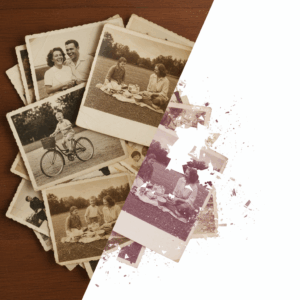 Imagine the soft, brittle crackle of an old photograph. As you lift it from a dusty box, a faint, sweet scent of aged paper fills the air. Suddenly, a warm, unexpected rush washes over you. You see your younger self, bathed in a beam of pure summer light. These pictures are more than mere objects; they are anchors. They capture the texture of your childhood blanket and reveal the warm, velvety glow of a parent’s living room lamp. They hold the joyful sounds of laughter from someone you didn’t know you would miss.
These images are your personal history. But they are in great danger.
Your Photo Memories Face Accelerated Decay
Your physical photos are an endangered class of artifacts. They are a library that is on the verge of collapse. The vivid, dye-based colors of a 1970s snapshot are fading. Subtle silver particles on mid-century prints are disappearing. Intricate emulsions on old film are breaking down. This is called accelerated decay. Every year pushes them closer to dissolution. Moisture, light, and the simple chemistry of time destroy them. They turn moments of sharp clarity into muddy, indecipherable stains. You must act now to preserve old photos and protect your history.
The Critical Rescue Operation
The process of high-resolution digitization is more than just a convenience; it is a critical rescue operation. When you scan an image properly, you stabilize it and give it a new, permanent form. This act is a defiance against the fading effects of time. It preserves the visual evidence of your personal history—those first steps, shared laughter, and the faces you vowed never to forget. We are not merely making copies; we are transcribing the past into a format that the future can easily understand.
Once your old photos, slides, and films are converted into digital files, AI technology becomes a powerful tool to enhance your memories. It quickly repairs damage caused by time, removing scratches, correcting faded colors, and sharpening blurred faces. More importantly, AI organizes everything instantly, using facial recognition to identify people and image recognition to label locations and events. This means you can finally locate any picture you want without the hassle of sorting through thousands of files, transforming your disorganized photo collection into a beautifully organized family history book ready to be shared.
The Hard Truth of Waiting
Too many people know they need to digitize photos. Yet, they wait. One journalist, Jennifer Jolly, tech columnist at USA Today, confessed she was so “overwhelmed” by the task. She kept her “precious family memories” shoved into a closet for ten years. It took “the unthinkable—a life-altering family tragedy in November” — for her to finally confront those dusty boxes. She needed to create a memorial for her loved one. That is when the need became urgent. She found that the professional process turned thousands of images and film into digital files in “less than 48 hours.” Her story proves a hard truth. Professional, systematic rescue is necessary because individual effort often fails. For her, the digital access was “the single most meaningful service” she had ever experienced. It allowed her family to heal.
Do not wait until a tragedy forces you to act. The time to save these irreplaceable artifacts is before disaster strikes.
How to Save Your Family’s Archive
You must make a plan to convert printed photos to digital. Follow these steps to start your rescue mission today:
- Gather Everything: Collect all your boxes of old photographs, slides, and film. Do not worry about organizing them perfectly at this time. Just get them out of the basement.
- Choose a Professional: Select a high-resolution photo scanning service. Look for a company that specializes in bulk photo scanning.
- Ship and Stabilize: Send your collection to be digitized and stabilized. This secures your history. It stops the decay before it is too late.
- Enjoy the Results: Once digitized, your memories are safe and secure. You can finally share them. You can create new traditions by reliving old moments.
This is the central, often-ignored imperative: The physical photographs of the 20th century are irreplaceable. Their time is nearly up. To neglect this archive is to accept the slow, inevitable deletion of your family’s documented memory. You must take this action now.
Frequently Asked Questions (FAQ)
Q: How quickly do old printed photos fade?
A: The fading of photos depends mainly on their storage conditions. High temperatures, humidity, and exposure to light can speed up the deterioration process. Many color photos from the 1970s and 1980s are already exhibiting noticeable color shifts and fading. To preserve the best remaining quality, it’s advisable to take action within the next few years.
Q: Is scanning them at home just as good as a professional service? A: Home scanning is time-consuming and often misses proper archival quality. Professional photo scanning services utilize specialized equipment to capture higher detail and accurately reproduce colors. They handle large volumes efficiently, which saves you hundreds of hours.
Q: What is the biggest mistake people make with old photos? A: The biggest mistake is waiting. People are often “overwhelmed” by the project and put it off. Every day you wait means the physical image continues to degrade, making the digital copy less clear.
Related Reading to Continue Your Rescue Mission
To learn more about saving your visual history, explore these stories:
The Great Photo Blackout: Why So Many Photos Stay Hidden Forever
Preserve Your Family History with Photo Scanning
Why Your Old Slides and Negatives are the Most Endangered
P.S. Grateful for you taking the time to read this. Hope it was useful.