
Millions Rent Storage Units, but What Happens to the Family Photographs Forgotten Inside Those Boxes?
Old printed photographs may spend decades in storage, exposed to damaging conditions while the people who remember their stories grow older. Millions of Americans rent storage units. Some pay every month to keep family photographs they haven’t looked at in decades.
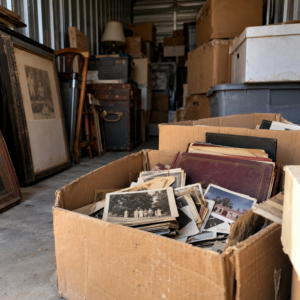
Every month, Americans pay to store things they don’t have room for at home. Furniture, holiday decorations, clothing, old appliances. Somewhere behind those roll-up doors are boxes of family photographs nobody has opened in years. You might be paying rent for pictures you haven’t looked at since 1995. According to TractIQ’s August 2026 self-storage market data, the United States has approximately 68,000 storage facilities with nearly 2.5 billion square feet of rentable space. How many contain old family photographs? Nobody seems to know. But anyone who has helped a parent downsize or cleaned out a relative’s home knows how easily photographs end up there.
I’m thinking about the boxes marked FAMILY PHOTOS. The trays of 35mm slides from your parents’ vacations. The envelopes of negatives from the days when every roll of film came back with prints. The little reels of home movies that haven’t been watched since someone put away the family projector.
Remember What We Went Through to Take Those Pictures?
We bought cameras. We bought film. We dropped off our exposed rolls at the photo lab, paid to have them developed, then waited to see what came back. Remember opening those envelopes? Some pictures were blurry. Somebody always had their eyes closed. Occasionally, half the photograph was somebody’s thumb. We kept them anyway.
Those pictures followed us through moves, new homes, and growing families. Eventually, they ended up in boxes. Maybe our parents were downsizing. Maybe we inherited a collection nobody had sorted through. Years passed.
What Happens to Old Photos in Storage?
Heat accelerates the chemical changes that damage photographic materials. High humidity promotes mold growth, while moisture can cause prints to stick together. Water leaks, insects, and rodents pose additional risks. Slides and negatives are also vulnerable, and some contain images that were never printed. Old 8mm and Super 8 home movies may develop a chemical condition called vinegar syndrome, which can cause the film to emit a vinegar-like odor, shrink, or become brittle.
The National Archives recommends keeping photographic collections in cool, dry, stable conditions. Climate control helps, but it doesn’t guarantee proper preservation. Many photographs survive decades in good condition. The trouble is that you may not know what’s happening until you open the boxes. There’s Something Else We’re Losing
The people who remember the photographs are getting older. You might recognize everyone in that family reunion picture today. Will your children recognize them 20 years from now? Who took the picture? Where was it taken? Who’s the little boy standing next to your grandfather?
Those answers aren’t always written on the back. Sometimes the only person who knows the story is someone you haven’t asked yet.
I’ve spent 36 years in the photo industry, and I still find it remarkable how much effort families once put into taking pictures, only to stop looking at them. We paid for cameras, film, developing, prints, and albums. We saved everything for decades. Now some of us are paying monthly fees to keep those photographs out of sight.
And the stories behind them may be disappearing faster than the pictures themselves.

How to Bring Those Photographs Back Into Your Life
Digitizing old photographs makes them easier to see, share, and protect. Prints can be scanned. You can convert slides and negatives into digital images. You can transfer old home movies into video files using equipment designed for those formats. Imagine sending your brother a picture of you two standing beside your first car. Showing your children what their grandparents looked like at 25. Putting decades of family photographs on a digital frame. Watching an old home movie with relatives who haven’t seen it since childhood.
I’ve always found the conversations around old photographs especially interesting. Someone recognizes the neighbor in the background. Another person remembers the house. A relative finally identifies someone nobody could name. An ordinary snapshot becomes a story you’ve never heard before. Digital files need protection too. Keep backup copies in separate places and check them occasionally. Hold on to the original photographs, which may contain handwriting or details worth preserving.
Four Questions Worth Asking
- Is it safe to keep photographs in a storage unit? A cool, dry, stable environment is best. If you must use a storage facility, choose one with appropriate climate control. Use archival-quality enclosures and keep everything off the floor.
- What if photographs are stuck together or smell musty? Don’t pull them apart. You could damage the image. Moldy or water-damaged materials may need attention from a qualified photograph conservator.
- Which photographs should I digitize first? Start with the oldest, most fragile, or most meaningful pictures. Ask relatives to identify people, dates, and places while they still can.
- Should I throw away the originals after scanning? Generally, keep them. A digital copy makes the picture easier to enjoy, but the original may contain information the scan doesn’t capture.
Before You Pay Another Month of Rent
The next time you visit your storage unit, find those boxes of photographs. Open them. Check for damage. Bring them home if you can. You don’t have to organize an entire lifetime of pictures in one weekend. Start with one box. At ScanMyPhotos.com, we’ve helped families digitize photographs for decades. What matters most to me is seeing those pictures become part of family life again. Someone recognizes a face. A conversation begins. A forgotten moment gets shared.
Storage units serve a useful purpose. But family photographs aren’t old furniture. You can replace a chair. You can buy another lamp. You might even find another dining room table just like the one you’ve been paying to store for ten years. You can’t go back to 1978 and take another picture of your family standing in front of the house where you grew up.
You went to a lot of trouble to take those photographs in the first place. It’s worth a little trouble to see them again.
Revised on October 13, 2026