Your Own Vacation Photos Shouldn’t Be Harder to Find Than a Stranger’s
Every day, if you’re like millions of other people and me, you search TikTok, Instagram, YouTube, and AI tools to experience places through somebody else’s life. A stranger’s honeymoon in Italy. Someone’s food tour in Tokyo. A perfect Maui sunset filmed by an influencer with a drone. Within seconds, we can watch thousands of other people’s adventures in vivid detail. We know where they stayed, what they ate, which beach they visited, and what the hotel pool looked like at sunset. But what about digitizing printed photos?
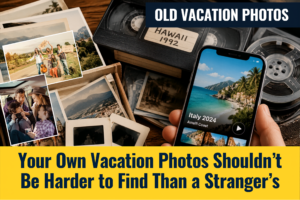
Meanwhile, many families cannot instantly access their own trip to Hawaii, Disneyland, Europe, or that cross-country road trip in the station wagon. Those memories exist. They are just trapped offline, inside slide carousels, photo albums, yellow Kodak envelopes, old movie reels, and boxes nobody has opened in decades.
That is the strange thing about modern life. Technology made the world searchable, except for much of our own personal history. Before social media, people documented travel differently. Photos were not posted for strangers. They were taken for the people who were actually there. A dad filming his kids at the Grand Canyon on Super 8 film. Parents standing in front of a motel sign on Route 66. A blurry castle photo at Disneyland that somehow still feels magical. Nobody cared if the lighting was perfect. The photos mattered because the memory mattered.
Today, we have instant access to millions of other people’s experiences while many of our own remain locked away where nobody sees them anymore. Until they are digitized. That is when something surprising happens. Your memories suddenly work the way modern life does. They become searchable, shareable, and instantly accessible.
You can find Hawaii 1978. Mom at Disneyland. Dad skiing in Aspen. Your first trip to New York. A beach vacation with someone you miss deeply now. Suddenly, your family history is no longer trapped in storage bins. It becomes part of daily life again.
Not content. Not influencer travel videos. Your life. Your adventures. Your history. And unlike the endless stream of vacation videos online, these memories are something the internet can never recreate. Because they belong to you.
How to Digitize Old Slides, Photos, and Home Movies
Millions of families still have slides, printed photos, negatives, VHS tapes, and home movies stored away because they are no longer easy to access. Projectors break. Carousel trays sit untouched. Film fades. VHS players disappear. Many people simply do not know where to begin.
The easiest way to start is by gathering everything in one place. Slide trays, photo albums, envelopes from old photo labs, negatives, movie reels, VHS tapes, and even random drawers filled with loose pictures can all be digitized. Once converted into digital files, those memories can be viewed instantly on phones, TVs, tablets, laptops, cloud storage, and digital photo frames.
Slides can be scanned into high-resolution digital images. Printed photos can be organized into searchable folders. Old VHS tapes and home movies can be converted into digital video files that are finally easy to watch and share again. Many families are shocked when they realize they have not seen these moments in 20 or 30 years simply because the technology to view them disappeared.

The emotional part comes later. Families often begin the process thinking they are organizing storage boxes. Instead, they rediscover entire chapters of their lives. A grandparent laughing in the backyard. A forgotten vacation. A childhood birthday party. A parent decades younger than you remember them today.
That is why digitizing old memories is no longer just about preservation. It is about access. In a world where we can instantly search almost anything online, people are realizing they want the same instant connection to their own lives and family history.
At ScanMyPhotos.com, families can digitize slides, printed photos, negatives, and home movies so their memories become easy to search, relive, and share again. Because the best travel memories are not always the ones online. Sometimes they are the ones already sitting in your own home.
Frequently asked questions about digitizing old printed photos, slides, VHS tapes, and home movies.
FAQ 1: What is the best way to digitize old slides?
The best option depends on how many slides you have. Small collections can sometimes be scanned at home, but large family archives are often easier to digitize using professional slide scanning services that handle carousel trays, Kodachrome slides, and old negatives safely and efficiently.
FAQ 2: Can old VHS tapes and home movies be digitized?
Yes. VHS tapes, Hi8 tapes, Super 8 film, 8mm film, and other older movie formats can all be converted into digital video files that are easier to watch, share, and preserve.
FAQ 3: Why are people digitizing family photos now?
Many families realize they have thousands of important memories they rarely see because they are trapped in outdated formats. Digitizing makes those memories instantly accessible again on modern devices while also helping protect them from fading and damage.
FAQ 4: What can you do with digitized photos and videos?
Once digitized at ScanMyPhotos, family memories can be viewed on phones, smart TVs, tablets, laptops, digital frames, and cloud storage. They can also be organized into searchable folders, shared with relatives, turned into photo books, or used in memorial videos and family history projects.
[Edited June 10, 2026]